
Welcome And Learning Objectives
Good evening, everyone. Welcome.
₦5 million is missing. An invoice carries a familiar signature. Someone points at an employee and says: “It must be him.”
But… is the invoice genuine? Was the payment authorised? Does the evidence support the accusation?
An investigation must establish facts. Starting with a verdict can send you in the wrong direction.
Yesterday, we examined crime, behaviour and society’s response. Tonight, we focus on how to examine suspected wrongdoing carefully and fairly.
By the end of this class, you should be able to:
→ Explain forensic investigation and the basic features of fraud.
→ Recognise common fraud schemes and distinguish warning signs from proof.
→ Describe how to assess an allegation and plan an investigation.
→ Identify evidence sources and explain basic preservation and documentation principles.
→ Understand chain of custody and why handling records matter.
→ Recognise unusual transactions and inconsistencies that require further examination.
→ Describe fair interviewing practices and test alternative explanations.
→ Present findings clearly, acknowledge limitations and recommend practical controls.
This is a foundation class. Specialist examinations require appropriate training, and any investigation must stay within your authority.
Throughout tonight, keep asking:
What do we know… how do we know it… and what still needs checking?
What Is Forensic Investigation?
A warehouse fire destroys stock worth millions. The owner calls it an electrical fault. An employee mentions a threat made the previous week.
Both accounts deserve examination… neither settles the cause.
Forensic investigation is the systematic examination of evidence to establish facts that may be used in legal proceedings.
In this case, specialists might examine the fire scene, electrical systems, CCTV, access records and witness accounts.
They would test possible explanations and document what supports—or contradicts—each one.
It goes far beyond fingerprints.
Depending on the matter, forensic work can involve:
→ Physical evidence: Objects, materials and traces.
→ Documents: Contracts, receipts and signatures.
→ Digital evidence: Emails, messages and device records.
→ Financial records: Payments, accounts and transaction histories.
Different specialists handle different examinations. A fraud investigator is not automatically qualified to determine the cause of a fire.
THE PROCESS MATTERS.
→ Work within proper authority.
→ Preserve evidence and document its handling.
→ Use suitable methods and qualified specialists.
→ Test alternative explanations.
→ Report findings and limitations honestly.
Fraud investigation focuses on suspected deception. Forensic investigation has a broader scope.
The warehouse findings might reveal an accident, deliberate damage or an unresolved cause.
An investigation must leave room for all three… until the evidence supports a conclusion.

Understanding Fraud: Deception, Intent And Gain
A recruitment agent collects ₦150,000 from Amina for a “confirmed job placement.”
There is no employer. No vacancy. The appointment letter was fabricated.
The job did not fall through… it never existed.
Fraud involves deliberate deception intended to obtain an improper benefit or cause someone a loss.
Three ideas help us understand it:
→ DECEPTION
Someone creates a false impression through lies, misleading information or dishonest concealment.
In Amina’s case, the fake vacancy and appointment letter made the offer appear genuine.
→ INTENT
The deception is deliberate. This is what separates fraud from an honest mistake.
An investigator must examine what the person knew and intended. Relevant evidence might include messages, fabricated records and repeated conduct.
An error alone does not establish dishonest intent.
→ GAIN OR LOSS
The deception is intended to secure a benefit for someone or expose another person to loss.
The benefit could involve money, property, services or avoiding a payment. The intended beneficiary does not have to be the person telling the lie.
Actual payment or a completed loss is not always necessary for fraudulent conduct or an attempt to be investigated.
BE CAREFUL WITH THE WORD “FRAUD.”
A delayed delivery, unpaid debt or failed investment does not automatically prove fraud.
Ask:
→ What was represented?
→ Was it false or misleading?
→ What evidence suggests the person knew?
→ What benefit or loss was intended?
These are useful investigative questions. The precise legal requirements depend on the offence and jurisdiction.
Start with the alleged deception… then examine the evidence of intent.

Types Of Fraud In Everyday And Workplace Settings
A job that never existed. An expense that was never incurred. A supplier paid for goods never delivered.
Different settings… but each may involve someone using deception to obtain a benefit.
Fraud can come from outside an organisation, inside it—or through people working together.
→ PURCHASE AND ADVANCE-FEE FRAUD
Collecting money through false promises of goods, services or opportunities.
Example: A fake travel agent collects visa-processing fees using fabricated documents and an invented appointment.
→ INVESTMENT FRAUD
Using false claims to attract people’s money.
Example: An operator claims profits come from trading, while secretly using new investors’ deposits to pay earlier participants.
→ IMPERSONATION AND PAYMENT DIVERSION
Pretending to be a trusted person or organisation to redirect money or obtain sensitive information.
Example: A message appearing to come from a supplier announces “new bank details.”
→ PAYROLL FRAUD
Deliberately manipulating payroll to obtain improper payments.
Examples include fictitious employees, inflated working hours or unauthorised salary changes.
→ EXPENSE AND INVOICE FRAUD
Submitting false, altered or duplicate claims.
Example: An employee claims reimbursement for a journey they never made.
→ PROCUREMENT FRAUD
Using deception in purchasing or contract awards.
Example: A procurement officer presents three supposedly independent quotations that were secretly prepared by the same supplier.
→ FINANCIAL REPORTING FRAUD
Deliberately falsifying financial records to mislead others.
Examples include invented sales, concealed liabilities or manipulated expenses.
→ INSURANCE AND BENEFIT FRAUD
Knowingly making false statements to obtain payments or entitlements.
Example: Claiming compensation for equipment that was never owned or lost.
THE SCHEMES CAN OVERLAP.
A fictitious supplier may be created through procurement fraud, paid through false invoices and supported by misleading accounting entries.
But remember… a failed transaction, missing document or unpaid debt does not automatically establish fraud.
Identify the suspected deception, examine intent and trace the benefit or intended loss.
The Fraud Triangle: Pressure, Opportunity And Rationalisation
Bola changes a sales figure so her branch appears to have met its target.
Her explanation? “If we miss it again, people could lose their jobs. I am protecting my team.”
She knows the figure is false… but has found a reason to justify it.
The fraud triangle examines three factors that may come together in fraud.
→ PRESSURE: “I NEED TO DO SOMETHING.”
A financial problem, personal ambition or workplace demand creates pressure.
It could involve debt, maintaining a lifestyle, protecting a bonus or meeting an unrealistic target.
For Bola, it is the fear of missing the target and its consequences.
→ OPPORTUNITY: “I CAN MAKE IT HAPPEN.”
The person sees a weakness they believe they can exploit without being detected.
Bola can edit the sales report, and nobody independently compares it with actual transactions.
Other opportunities include unchecked payments, shared passwords and managers overriding controls.
→ RATIONALISATION: “MY REASON MAKES IT ACCEPTABLE.”
The person explains away the dishonesty.
“I am protecting jobs.”
“They owe me anyway.”
“It is only temporary.”
An excuse can make wrongdoing easier to accept… without making it right.
HOW DO WE USE THIS MODEL?
→ Address pressure: Set realistic expectations and provide appropriate support.
→ Reduce opportunity: Separate duties, restrict access and independently review records.
→ Challenge rationalisation: Make it clear that results do not justify dishonest methods.
USE IT CAREFULLY.
A person under pressure is not automatically dishonest. Access is not proof of abuse. The triangle is a framework for understanding risk—not a test of guilt, and it does not explain every fraud.
Examine the conduct and the evidence… not just whether someone’s circumstances fit the triangle.

Fraud Warning Signs: Indicators Versus Proof
A supplier changes its bank details. The next payment is unusually large. The officer who approved it becomes defensive when questioned.
“Three red flags. That settles it.”
No… it gives you three things to examine.
Warning signs identify concerns. They do not establish guilt.
→ WHAT IS AN INDICATOR?
An unusual pattern, discrepancy or weakness that warrants further checking.
Examples include:
→ Duplicate invoices or unexplained payments.
→ Missing supporting records.
→ Sudden changes to payment instructions.
→ Repeated approval overrides.
→ Records that contradict one another.
→ Resistance to independent checks.
Each may have an innocent explanation—or reveal deliberate wrongdoing.
→ WHAT DOES PROOF REQUIRE?
Evidence sufficient to establish the relevant claim under the applicable standard.
In a suspected payment-diversion case, examine:
→ Whether the change request was genuine.
→ Whether money actually left the account.
→ Who controlled or benefited from the receiving account.
→ Who took the relevant actions.
→ What supports deliberate deception rather than error.
One verified fact may establish part of the story without proving the whole allegation.
A bank record may confirm where money went. It does not automatically establish who organised the transfer or what they intended.
→ BEHAVIOUR NEEDS CAUTION
Nervousness, anger, debt or an expensive lifestyle do not prove fraud.
An innocent employee may become defensive because they feel accused.
→ RESPOND WITH DISCIPLINE
Preserve records, verify independently, test alternative explanations and document what remains uncertain.
Write: “The bank-detail change has not been independently verified.”
Do not turn that into: “The payment officer stole the money.”
Several indicators can strengthen the reason to investigate… but suspicion still needs testing.

Roles, Responsibilities And Limits Of An Investigator
“Lock the door. Nobody leaves until someone confesses.”
The manager wants answers… but appointing someone to investigate does not give them unlimited power.
An investigator establishes facts within their authority. They do not manufacture a confession or decide the outcome in advance.
→ CLARIFY THE ALLEGATION
Identify exactly what is being alleged, what questions need answering and who authorised the work.
“Find something against him” is not a proper investigation brief.
→ OBTAIN AND EXAMINE EVIDENCE
Identify relevant records, preserve them properly and compare information from different sources.
Examine material that supports the allegation… and material that challenges it.
→ INTERVIEW FAIRLY
Ask clear, neutral questions. Give people an opportunity to explain discrepancies and identify supporting records.
Threats, humiliation and pressure can harm people and undermine the reliability of their accounts.
→ DOCUMENT THE WORK
Keep accurate notes of evidence sources, handling, interviews, decisions and limitations.
Someone reviewing the case should be able to follow how the findings were reached.
→ REMAIN INDEPENDENT
Disclose conflicts of interest. Do not allow friendship, seniority or pressure from management to determine your conclusions.
→ REPORT FINDINGS
Explain what is established, what remains uncertain and which controls need improvement.
KNOW YOUR LIMITS.
→ An internal appointment does not grant police powers.
→ Access must stay within the permission and authority given.
→ Do not search personal accounts simply because you know the password.
→ Refer specialist examinations to qualified professionals.
→ Escalate matters beyond your competence or mandate.
→ Leave disciplinary decisions and criminal determinations to the appropriate decision-makers.
Your responsibility is to produce a fair, traceable account of the evidence… even when the findings disappoint the person who appointed you.
Receiving Allegations And Making An Initial Assessment
An anonymous email arrives: “Your procurement manager owns the company supplying your office. Check the payments.”
No name. No attachments.
Do you dismiss it as gossip… or confront the manager immediately?
Neither response gives the information a fair assessment.
An allegation is a claim that something happened. The initial assessment determines what needs checking, how urgently and who should handle it.
→ CAPTURE THE DETAILS
Preserve the original report and any attachments. Record when and how it arrived.
Identify what is alleged, who or what is involved, the relevant period and any suggested evidence sources.
→ CLARIFY THE BASIS
Where you can contact the reporting person, ask:
→ What did you personally observe?
→ What came from someone else?
→ Which records or witnesses could help?
→ Is there anything you are uncertain about?
Listen without supplying answers or promising a particular outcome.
→ CHECK URGENT RISKS
Could someone be harmed? Are questionable payments continuing? Could records disappear? Could the reporting person face retaliation?
Escalate urgent concerns through an authorised channel and arrange appropriate preservation.
→ ASSESS THE INFORMATION
Is the allegation specific enough to check? Does it concern possible fraud, an undisclosed interest, a procedural breach—or something else?
Owning a supplier company does not, by itself, establish fraud. Examine disclosure, involvement in decisions, representations and transactions.
→ CHECK WHO SHOULD HANDLE IT
Confirm responsibility, authority and independence.
A manager implicated in the report should not control its assessment.
→ EXPLAIN CONFIDENTIALITY
Restrict sharing to those who need the information. Do not promise absolute secrecy.
→ DOCUMENT THE NEXT STEP
The matter may need preliminary checks, formal investigation, referral or closure with recorded reasons.
Anonymous does not mean worthless. Detailed does not mean true. Assess what can be verified… before deciding what follows.
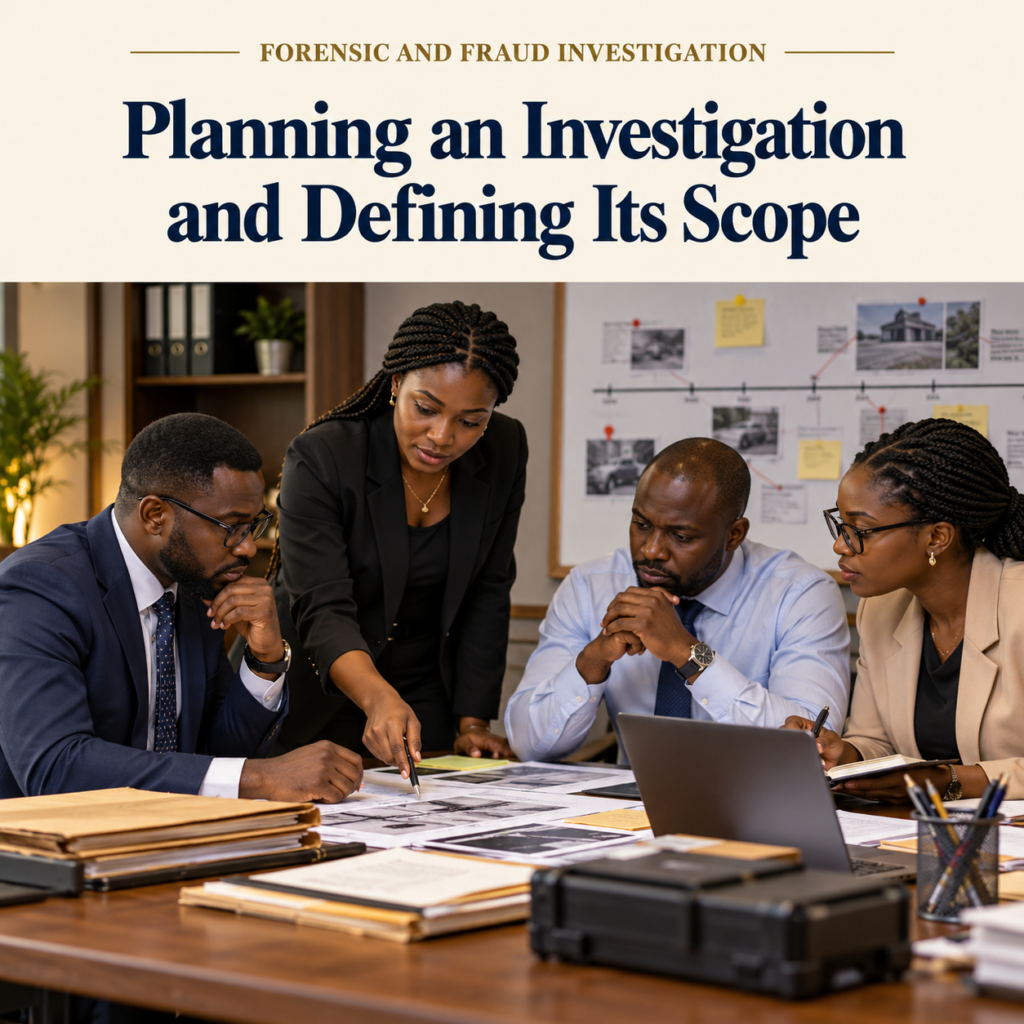
Planning An Investigation And Defining Its Scope
By Friday, the team has downloaded thousands of files, interviewed eight employees and spent hours reviewing CCTV.
Then someone asks: “Which allegation are we actually investigating?”
Silence.
Activity is not progress when the questions are unclear.
An investigation plan sets out what needs answering, what work is authorised and how the team will proceed.
→ DEFINE THE QUESTIONS
Turn a broad concern into specific questions.
For suspected false overtime claims:
→ Were the claimed hours actually worked?
→ Were the records deliberately altered?
→ Who submitted and approved the claims?
→ What payments resulted?
→ SET THE SCOPE
Specify the period, people, transactions, departments or locations covered.
“Review overtime claims at the Abuja branch from July to September” gives the work clear boundaries.
Record exclusions and their reasons too.
→ CONFIRM AUTHORITY AND INDEPENDENCE
Establish who authorised the investigation, what access is permitted and who receives the report.
Check conflicts of interest and identify any specialist assistance needed.
→ MAP QUESTIONS TO EVIDENCE
For overtime claims, relevant sources might include timesheets, duty rosters, payroll records, access logs and interviews.
An access log may show entry… it does not automatically prove hours worked.
→ PRIORITISE AND ASSIGN
Preserve records at risk of deletion or alteration. Decide who obtains records, conducts interviews and analyses findings.
Set realistic deadlines and secure handling arrangements.
→ PLAN TO TEST ALTERNATIVES
Could the discrepancy reflect a roster change, recording error or deliberate inflation?
Include checks that could challenge the allegation.
→ CONTROL CHANGES
If evidence points beyond the original scope, document why further work is needed and obtain appropriate approval.
The scope keeps the work focused… while a properly reviewed plan allows the evidence to change its direction.
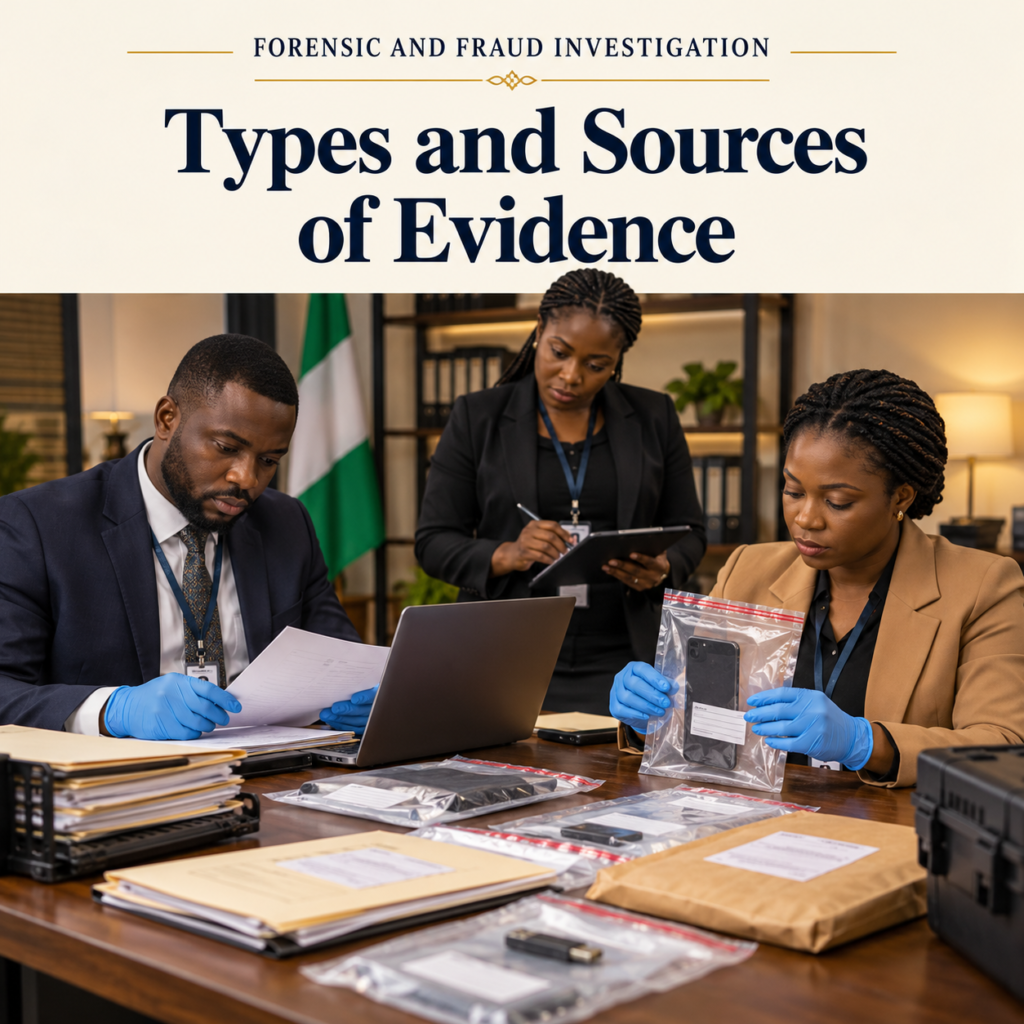
Types And Sources Of Evidence
“The CCTV will settle it.”
The footage shows Musa entering the store… but the shelves are outside the camera’s view.
It establishes that he entered. It does not show what he did inside.
Evidence has limits. Your job is to understand what each item can—and cannot—establish.
→ DOCUMENTARY EVIDENCE
Contracts, invoices, receipts, delivery notes and approval forms.
Sources: Procurement files, finance records, suppliers and other authorised record holders.
A signed invoice does not automatically prove that goods were delivered.
→ DIGITAL EVIDENCE
Emails, messages, CCTV, electronic transactions and system logs.
Sources: Authorised devices, business systems, backups and service providers through appropriate channels.
Preserve context. A screenshot may leave out important messages or details.
→ PHYSICAL EVIDENCE
Relevant objects or materials, such as equipment, packaging, damaged locks or original documents.
Sources: Relevant locations and people holding the items.
Some items require specialist collection, packaging or examination.
→ TESTIMONIAL EVIDENCE
Accounts provided by complainants, witnesses and subjects.
Sources: People with relevant knowledge.
Ask: “Did you see that yourself… or did someone tell you?”
A confident account can still be mistaken.
→ ANALYTICAL AND EXPERT FINDINGS
Results from examining evidence—for example, a payment comparison or specialist document examination.
Their strength depends on the underlying material, the method and the examiner’s competence.
CHECK THE SOURCE, NOT JUST THE CONTENT.
→ Is the item authentic?
→ Is it complete and relevant?
→ How was it obtained and handled?
→ Is the source independent?
→ What other evidence supports or challenges it?
These categories can overlap: an electronic invoice is both documentary and digital.
Ten copies of one unverified claim are still one unverified claim… not ten independent confirmations.

Collecting And Preserving Evidence
“Send me the screenshot. Then delete the chat so nobody knows you reported it.”
Stop… that chat may contain the dates, attachments and surrounding conversation needed to establish what happened.
The screenshot may capture one message. Deleting the conversation could remove the context that gives it meaning.
You can have a serious allegation and still damage the investigation through careless handling.
Collecting evidence means obtaining relevant material through authorised methods. Preserving it means protecting its condition, context and integrity so it can be examined reliably.
→ CONFIRM YOUR AUTHORITY
“Management asked me to investigate” is not permission to search every phone, email account or drawer.
Establish what you are authorised to obtain, from whom and through which procedure. If access is unclear, seek guidance before proceeding.
→ PROTECT MATERIAL BEFORE IT DISAPPEARS
CCTV may be overwritten. Records may be routinely destroyed. Messages may disappear.
Do not wait until next week to ask whether last month’s footage still exists. Arrange prompt preservation through authorised personnel.
→ RECORD WHERE IT CAME FROM
A document appears on your desk. It looks important… but who supplied it? Is it an original? Where was it kept?
Record the source, collector, date, time, location and condition. Where appropriate, photograph physical items in place before handling them.
→ LEAVE ORIGINALS UNALTERED
Do not circle suspicious figures, add notes, staple pages or “correct” dates on original documents.
Make working copies and mark those clearly.
Your notes must not become part of the material you are examining.
→ HANDLE AND PACKAGE APPROPRIATELY
Avoid unnecessary touching and keep items separate where needed. Packaging must suit the material.
Do not improvise with hazardous, fragile or unfamiliar items. Call someone qualified to handle them.
→ BE CAREFUL WITH DIGITAL MATERIAL
“Let me just open the laptop and check” can change files, logs or other information.
Do not casually open files, install software or change a device’s power or network state. Obtain authorised specialist guidance.
Preserve original messages, attachments and associated information where possible. A forwarded copy or screenshot may leave important details behind.
→ LABEL, LOG AND SECURE
Give each item a unique reference. Record handling and every transfer.
Store it securely and restrict access. A flash drive left on a shared desk is not under proper control simply because everyone in the office is trusted.
→ DOCUMENT ANY MISTAKE
If something is accidentally moved, altered or damaged, record exactly what happened.
Do not hide it. Concealing the mistake creates another reason to question the investigation.
Before anyone asks what the evidence proves… you must be able to explain where it came from and what happened to it.
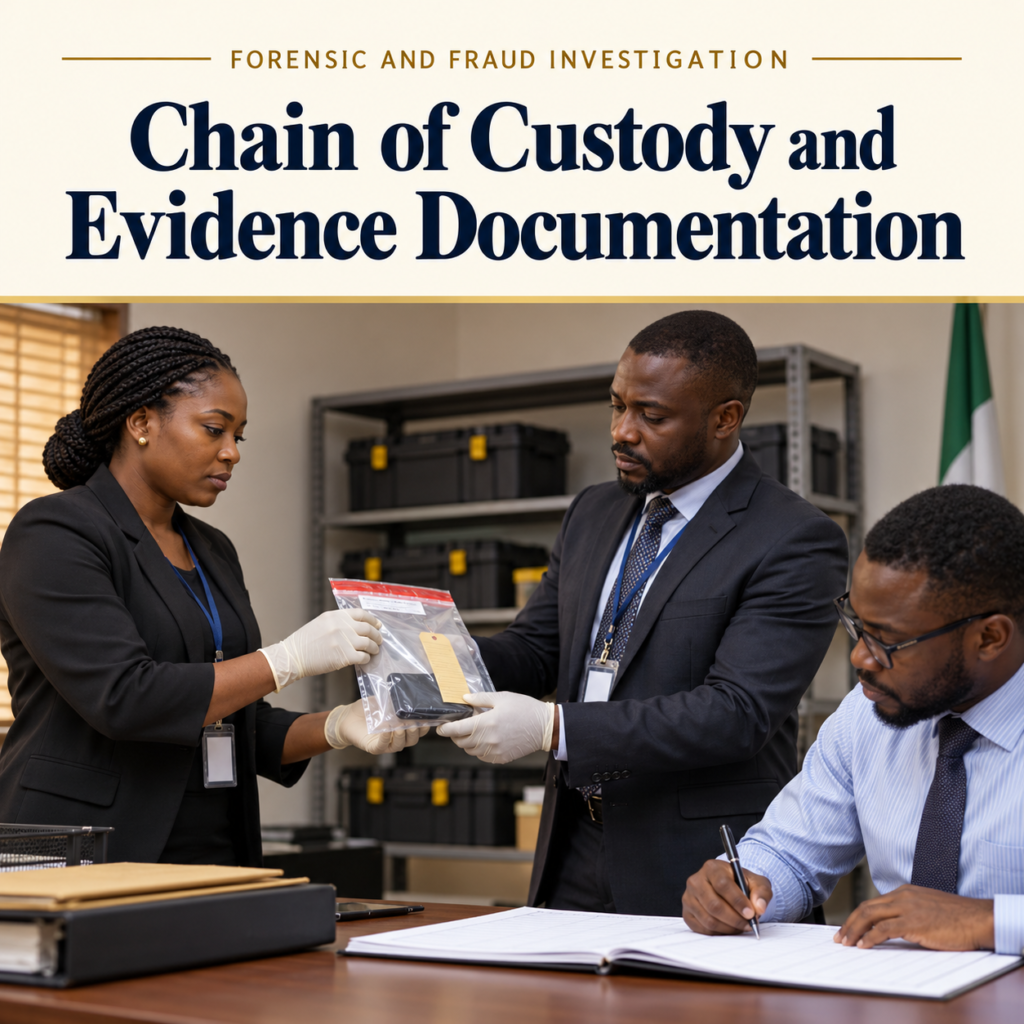
Chain Of Custody And Evidence Documentation
“Who collected this flash drive?”
“Bassey.”
“Who had it after him?”
“I think he gave it to someone in IT.”
“Was anything copied, added or deleted?”
Silence…
The drive is available. Its history is not.
That gap creates questions about whether it is the same item, who accessed it and whether anything changed.
→ WHAT IS CHAIN OF CUSTODY?
The documented history of an evidence item’s collection, possession, transfer, examination, storage and final disposition.
It helps establish what the item is, where it came from and what happened to it.
→ GIVE EACH ITEM A UNIQUE REFERENCE
Assign an identifier, such as E-001, and use it consistently.
“Bassey’s flash drive” is too vague—especially when several drives are involved.
Record:
→ A clear description and identifying features.
→ Where and from whom it was obtained.
→ Who collected it, with the date and time.
→ Its condition, packaging and seal details.
→ RECORD EVERY HANDOVER
“Please hold this for me” is still a transfer.
Document:
→ Who released and received the item.
→ The date and time.
→ Why it was transferred.
→ Its condition and seal status.
→ Both parties’ acknowledgement.
If the item moves again… record that too.
→ DOCUMENT ACCESS AND EXAMINATION
Who opened the package? Why? What examination occurred? Were copies or samples created? Where are they stored?
Record opening and resealing, including any new seal reference.
A sealed bag helps protect an item. The record explains its handling.
→ KEEP THE WIDER INVESTIGATION RECORD
Evidence documentation also includes:
→ Collection notes and photographs.
→ Interview records.
→ Examination methods and results.
→ Decisions, corrections and limitations.
Chain of custody tracks the item. These records explain the work performed and the basis for the findings.
→ UNDERSTAND DIGITAL INTEGRITY CHECKS
Specialists may calculate a hash value—a digital fingerprint used to check whether a file or forensic copy has changed.
A matching hash supports consistency between the items compared. It does not prove that the contents are true or identify who created them.
→ DEAL WITH GAPS HONESTLY
If a handover was missed, record the omission and seek reliable information to clarify it.
Never invent a signature or backdate an entry. Clearly identify a later account as a later account.
Do not build a perfect-looking record of something you cannot establish.
Chain of custody cannot make weak evidence strong. It helps others assess whether the material—and its handling—can be trusted.
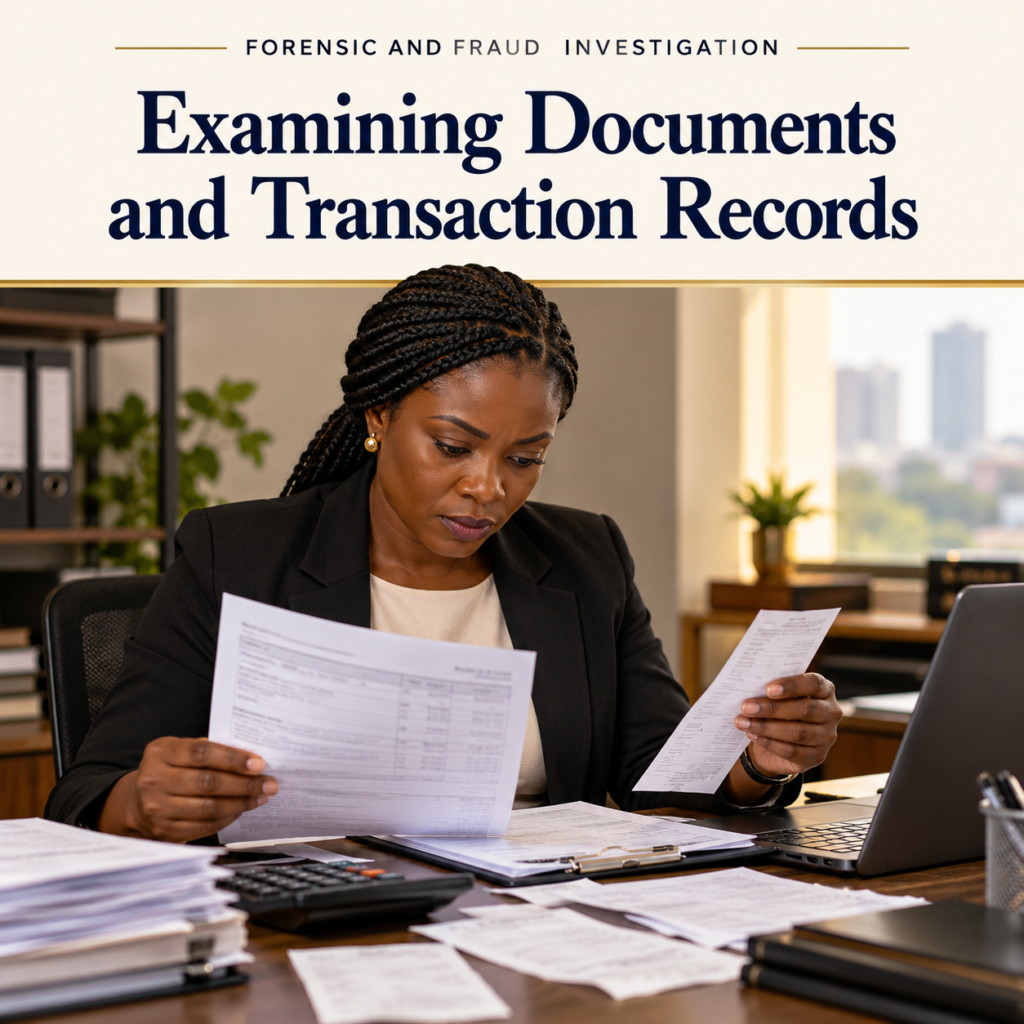
Examining Documents And Transaction Records
The file is complete. Purchase order… invoice… delivery note… approval.
“Everything is there,” the officer says.
Then you check the store. No equipment. You contact the supplier through an independently verified number. They deny issuing the invoice.
Complete paperwork can still tell a false story.
Your task is to examine whether the records are authentic, consistent and supported by what actually happened.
→ UNDERSTAND THE TRANSACTION FIRST
What was requested? Who approved it? What should have been delivered? How should payment have been processed?
You need the expected sequence before you can identify a meaningful departure from it.
→ COMPARE RELATED RECORDS
Match the purchase order, invoice, delivery note, goods-received record and payment record.
Check:
→ Supplier names and account details.
→ Dates and document references.
→ Descriptions, quantities and prices.
→ Calculations, approvals and payment amounts.
Do not stop because the totals agree. Several documents can repeat the same false information.
→ CHECK WHETHER THE TRANSACTION OCCURRED
An invoice requests payment. A receipt acknowledges payment. Neither, by itself, establishes that goods reached the organisation.
Look for supporting delivery records, stock entries, inspection records and other relevant evidence.
Where appropriate and authorised, verify the goods or services themselves.
→ VERIFY INDEPENDENTLY
Do not verify a suspicious invoice using only the telephone number printed on it.
Use an established supplier contact or another reliable source obtained independently.
Otherwise… you may simply ask the person behind the deception to confirm their own story.
→ CHECK THE MONEY MOVEMENT
Compare accounting entries with reliable payment records.
Did the money leave? Who received it? Was it reversed, refunded or paid again?
A record marked “paid” may reflect an entry that still needs verification.
→ EXAMINE DISCREPANCIES
Look into duplicate references, altered figures, missing approvals, unusual prices or dates that do not fit the sequence.
Ask for explanations and supporting records.
An inconsistency may reveal fraud… or an error. Establish which explanation the evidence supports.
→ KNOW WHEN YOU NEED A SPECIALIST
A signature looking different does not make you a handwriting expert.
Refer questions about forgery, ink, alterations or technical authenticity to a suitably qualified examiner.
→ DOCUMENT YOUR WORK
Use working copies. Reference each discrepancy to its source, record the checks performed and preserve the explanations received.
Do not merely count the documents in the file. Check whether the transaction behind them stands up to scrutiny.
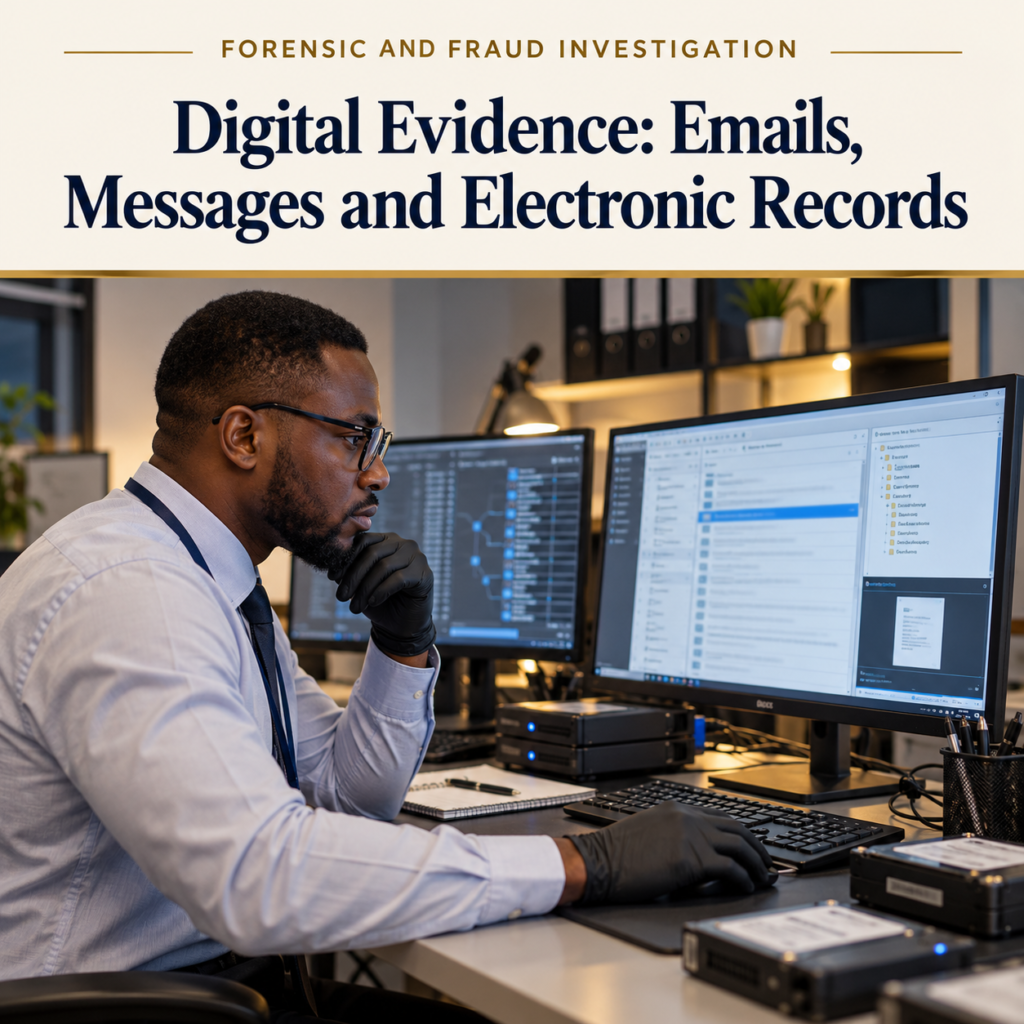
Digital Evidence: Emails, Messages And Electronic Records
The email carries the managing director’s name. The instruction is clear: “Pay today.”
The accounts officer processes the transfer.
Later, the director denies sending it.
“Then somebody is lying,” a colleague says.
Maybe… but was the address genuine? Was the account compromised? Did someone forward or alter the message?
Digital evidence needs examination—not blind trust in what appears on a screen.
→ WHAT COUNTS AS DIGITAL EVIDENCE?
Relevant information stored or transmitted electronically.
Examples include:
→ Emails and attachments.
→ Messages, voice notes and call logs.
→ Electronic invoices and payment records.
→ CCTV footage and system access logs.
→ Files and information about their creation or modification.
→ PRESERVE THE FULL CONTEXT
One message may look incriminating until you read the correction sent two minutes later.
Preserve the relevant conversation, attachments and original source where possible.
A cropped screenshot may be useful… but it may leave out information that changes the meaning.
→ CHECK THE ACTUAL SOURCE
A display name, profile photograph or company logo is not reliable identification.
Examine the actual address or account details and compare them with trusted records.
Even a genuine account may have been shared or accessed by someone else.
The account used and the person responsible are separate questions.
→ UNDERSTAND METADATA
Metadata is information about a digital item—such as timestamps, file properties or email-routing details.
It can help establish a sequence. But time zones, device settings, copying and later changes can affect how details appear.
Do not build a conclusion around a timestamp you have not properly understood.
→ AVOID CHANGING THE MATERIAL
“Let me quickly open it” can alter information.
Do not casually explore devices, install software or change power or network settings. Seek authorised specialist guidance.
Preserve originals and document the collection method, handling and any necessary changes.
→ COMPARE WITH OTHER EVIDENCE
Does the message align with payment records, approval procedures, access logs and witness accounts?
A login record may show that an account was accessed. It does not automatically establish who was at the keyboard.
→ RESPECT ACCESS LIMITS
Knowing a password does not give you permission to search. Obtain information through authorised channels and protect unrelated private material.
Report what the records establish… not what the screen initially made you believe.
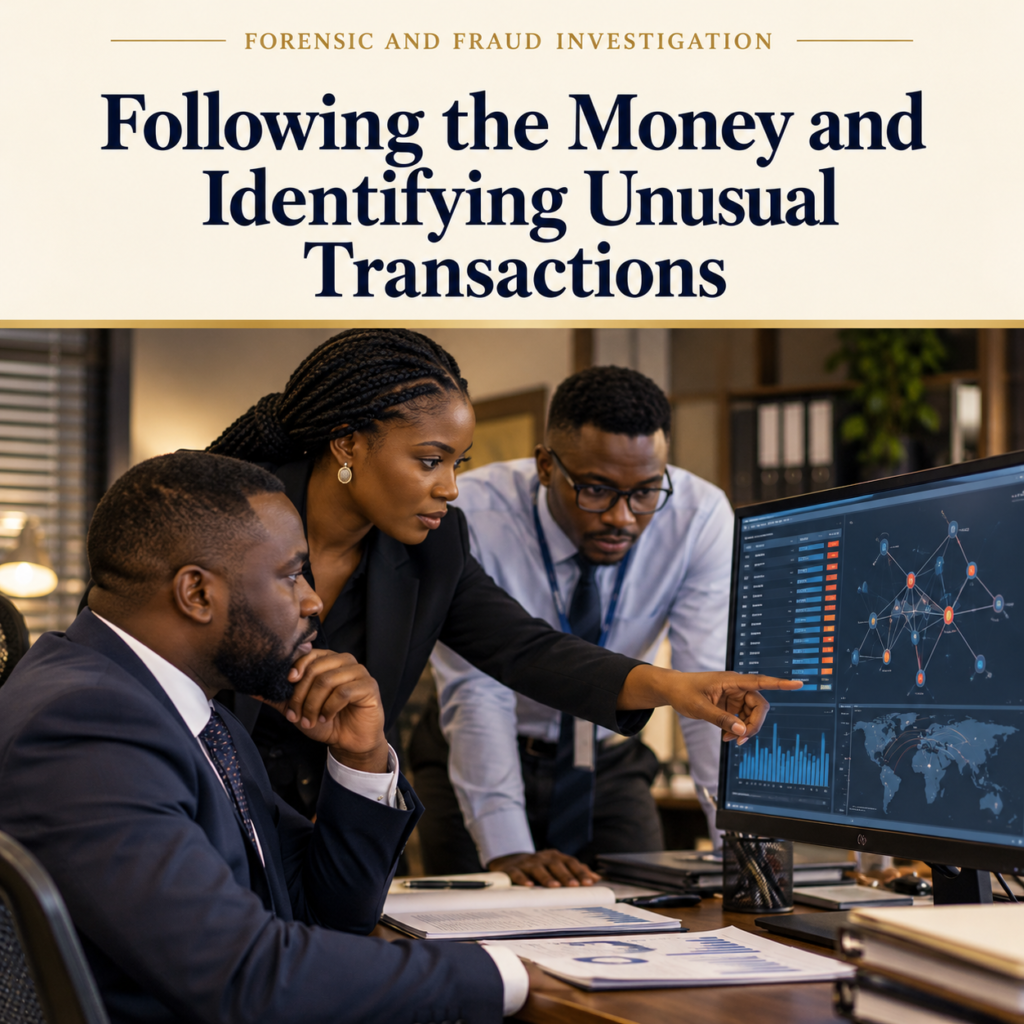
Following The Money And Identifying Unusual Transactions
The organisation paid ₦6 million for training materials.
The supplier received it… then transferred ₦900,000 to an employee’s personal account.
“Kickback,” someone declares.
It could be. But what was that transfer for? Was there a genuine separate transaction? Who controlled the accounts?
The movement raises a serious question. Your job is to establish the answer.
Following the money means tracing funds from their source through their movement and use, using records you are authorised to obtain.
→ ESTABLISH WHAT SHOULD HAVE HAPPENED
Who was entitled to payment? For what purpose? How much? Which approvals and supporting records were required?
Without that baseline, you cannot properly explain why a transaction is unusual.
→ TRACE WHAT ACTUALLY HAPPENED
Record:
→ The source and amount.
→ Sending and receiving accounts.
→ Dates and transaction references.
→ Further movements, withdrawals or refunds where records are available.
Do not skip a step because the next transfer “looks connected.” Establish the connection.
→ MATCH PAYMENT TO PURPOSE
Compare transfers with contracts, invoices, approvals and evidence of delivery.
A narration saying “consultancy” does not establish that consultancy occurred. Ask what service was provided and what supports it.
→ EXAMINE UNUSUAL PATTERNS
Examples include:
→ Repeated payments without a clear purpose.
→ Unexpected transfers to employees or connected parties.
→ Several transactions just below an approval limit.
→ Funds moving rapidly through multiple accounts.
→ Payments inconsistent with the goods or services received.
Patterns are leads… not verdicts.
Instalments, reimbursements and other legitimate arrangements may explain some movements. Test those explanations rather than accepting or dismissing them automatically.
→ IDENTIFY WHO BENEFITED
The named account holder is not necessarily the person who controlled or ultimately benefited from the funds.
Further records and independent checks may be needed.
→ BUILD A CLEAR MONEY TRAIL
Create a timeline linking each movement to its supporting record.
Distinguish confirmed transfers from suspected connections. Mark gaps openly.
→ RECOGNISE WHERE THE TRAIL STOPS
You cannot claim to know where money went beyond the records available. Further information may require an authorised request or referral.
“The money left the company” is a starting point. Establish where it went, why it moved and what the evidence supports.
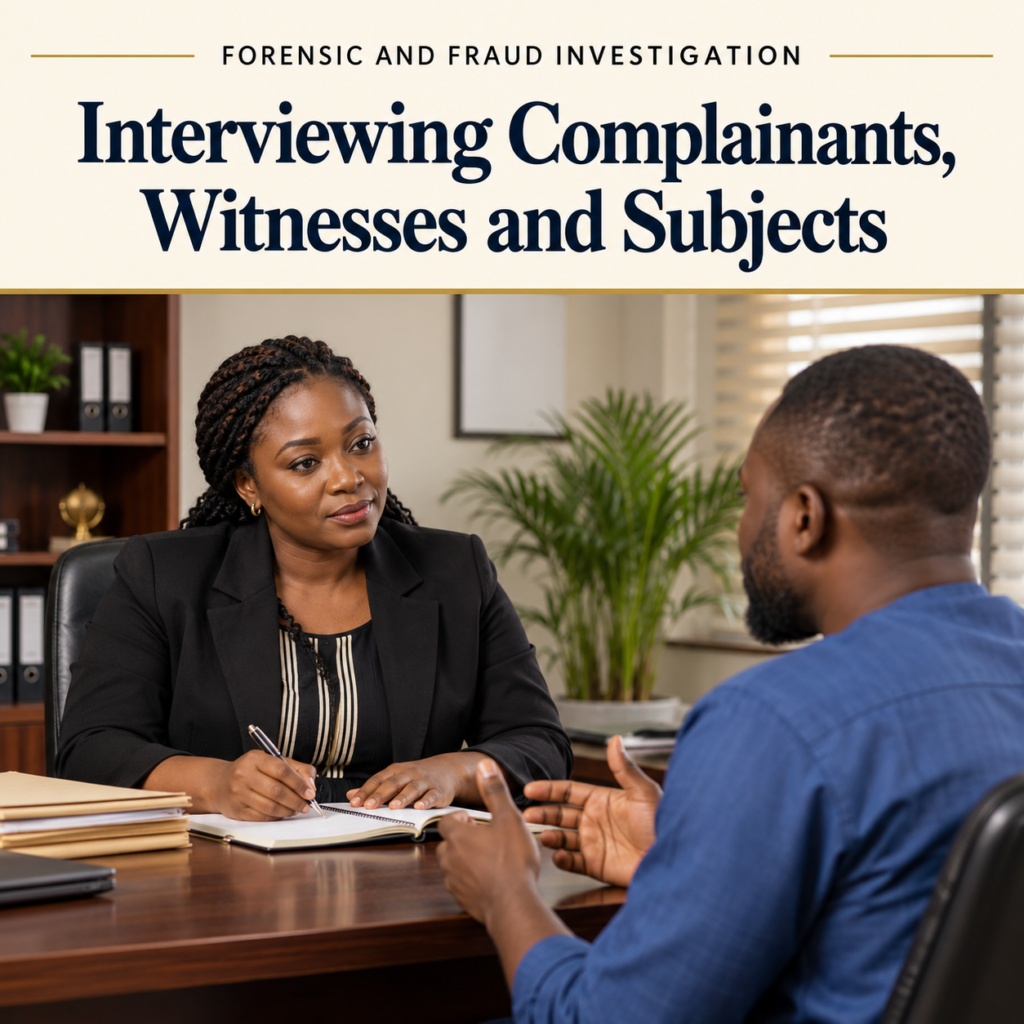
Interviewing Complainants, Witnesses And Subjects
Before Efe finishes explaining, the investigator interrupts:
“That cannot be true. Your colleague has already told us everything.”
Efe stops talking. From that point, he concentrates on defending himself.
The investigator may have lost useful information… while gaining an argument.
An interview should help establish what someone knows. Your certainty must not supply their answers.
→ UNDERSTAND THE PERSON’S ROLE
→ Complainant: Reports the concern.
→ Witness: May have relevant information.
→ Subject: Has conduct being examined.
A complainant may also be a witness. A person’s role may change as evidence emerges.
→ PREPARE BEFORE YOU SIT DOWN
Review available records, identify gaps and organise neutral questions.
Choose an appropriate setting. Explain the purpose, your role, recording arrangements and confidentiality limits. Follow applicable procedures and rights.
→ LET THEM GIVE THEIR ACCOUNT
Start with: “Please explain what happened, from the beginning.”
Listen. Allow pauses. Do not fill every silence or interrupt because the answer differs from your expectations.
Then clarify:
→ What happened next?
→ Who was present?
→ What did you personally see or hear?
→ Which records could help confirm that?
→ AVOID PUTTING WORDS IN THEIR MOUTH
“Did your manager tell you to falsify the invoice?” suggests an answer.
“What instructions did you receive about the invoice?” invites an account.
Ask one clear question at a time.
→ CHALLENGE FAIRLY
You do not have to accept every explanation.
Say: “You said the goods arrived on Monday. The delivery record shows Thursday. Please explain the difference.”
Give the person a genuine opportunity to respond and identify supporting evidence.
→ DO NOT READ GUILT FROM BODY LANGUAGE
Avoiding eye contact, sweating or becoming angry does not establish dishonesty.
Fear, stress, culture and individual differences affect behaviour.
→ RECORD ACCURATELY
Distinguish exact quotations from summaries. Check important details and document corrections transparently.
Use recordings only through permitted procedures, with any required notice or consent. Interview separately where appropriate to reduce accounts influencing one another.
→ CLOSE PROPERLY
Ask: “What have I not asked that you think matters?”
Clarify outstanding information and explain appropriate next steps without promising an outcome.
The interview gives you an account to examine… not a confession to force or a story to accept without checking.
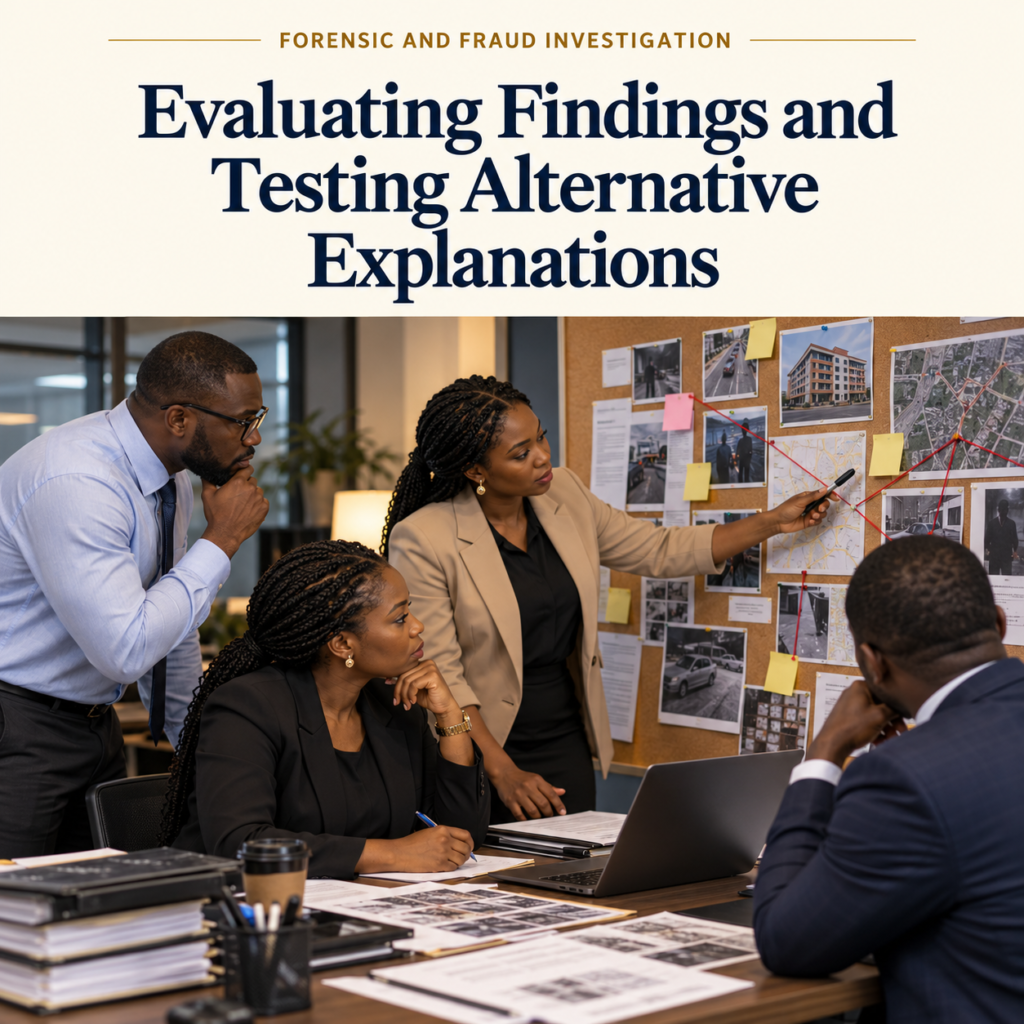
Evaluating Findings And Testing Alternative Explanations
The stock count shows 30 laptops missing. The storekeeper signed the records.
“Who else could have taken them?”
Then someone finds transfer notes showing equipment sent to another branch… but never entered into the central register.
The shortage still needs explaining. The first accusation no longer looks so certain.
Finding a discrepancy is one step. Establishing what caused it is another.
→ RETURN TO THE QUESTIONS
What was the investigation meant to establish?
Assess each allegation separately. Do not allow one confirmed irregularity to make every other accusation appear true.
→ ASSESS THE QUALITY OF THE EVIDENCE
Ask:
→ Is it authentic?
→ Is the source reliable?
→ Is important context missing?
→ What does it actually establish?
→ Was the method of examination appropriate?
A confident witness can be mistaken. A genuine document can contain false information.
→ TEST OTHER EXPLANATIONS
Could the discrepancy reflect:
→ A recording or calculation error?
→ A legitimate transaction entered late?
→ Shared access or mistaken identity?
→ Deliberate concealment or deception?
Identify what evidence would support or weaken each explanation… then check it.
An alternative needs testing—not automatic acceptance simply because someone suggested it.
→ SEEK INDEPENDENT CONFIRMATION
Compare accounts with reliable records and other sources.
Three reports copied from the same spreadsheet do not independently confirm that the spreadsheet is correct.
→ SEPARATE FACT FROM INFERENCE
“The storekeeper signed the stock record” may be established.
“The storekeeper stole the laptops” requires further evidence.
Explain the reasoning between your facts and your conclusion. Do not leave the reader to make an unsupported leap.
→ FACE CONTRADICTIONS
Include evidence that challenges your initial view. Record missing information and attempts to obtain it.
Do not quietly remove an inconvenient account because it makes the case harder to explain.
→ MATCH THE CONCLUSION TO THE EVIDENCE
A finding may be supported, not supported or unresolved, using the applicable investigation standard.
Insufficient evidence does not automatically mean a complaint was false. A procedural breach does not automatically prove fraud.
Before finalising, ask yourself:
“What evidence would change my mind… and have I genuinely looked for it?”
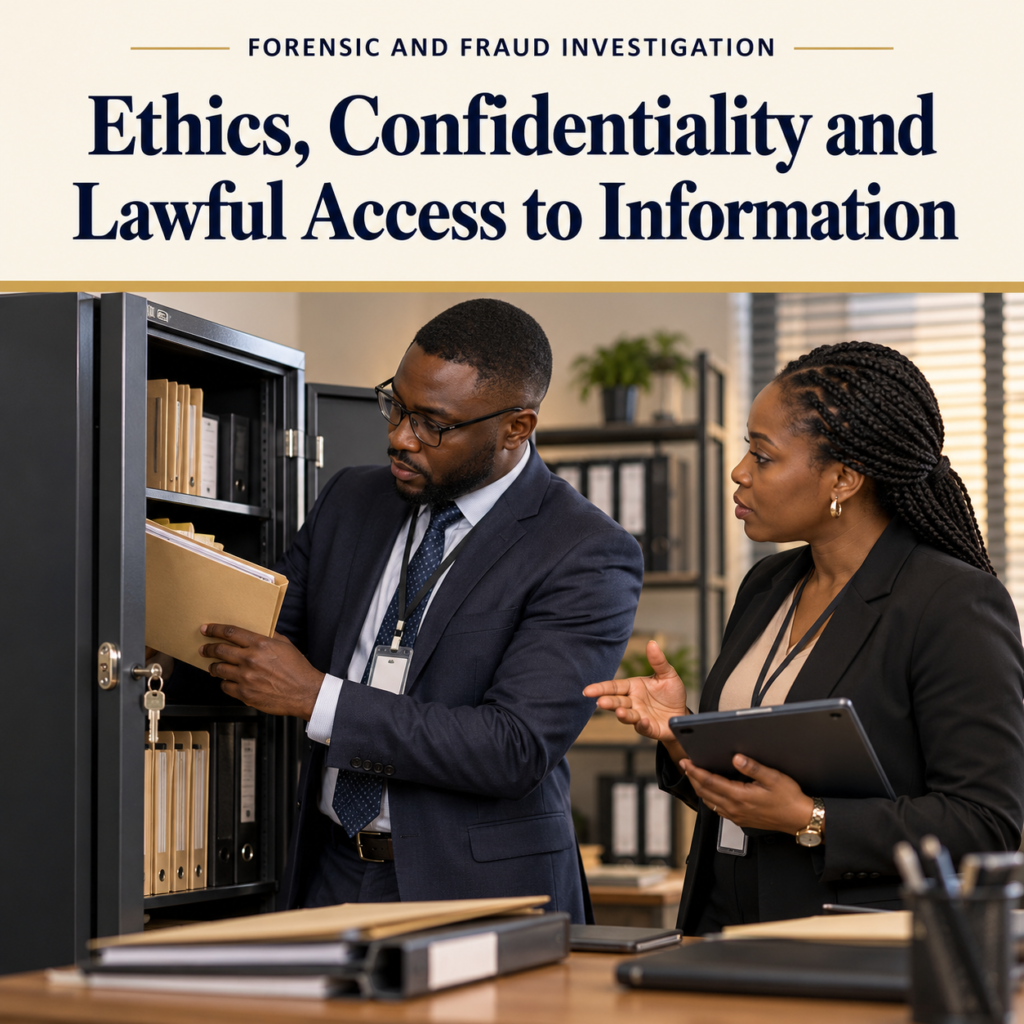
Ethics, Confidentiality And Lawful Access To Information
“Forward the employee’s bank statement to the management WhatsApp group. Let everybody see what we found.”
For what purpose? Who needs it? Does the statement include unrelated private transactions?
Having information does not give you permission to circulate it.
An investigation can expose wrongdoing… but careless conduct can also expose innocent people, damage reputations and compromise the work.
→ ETHICS: KEEP YOUR JUDGEMENT HONEST
Record facts accurately. Disclose conflicts of interest. Examine evidence that challenges the allegation.
If the evidence clears someone you personally dislike, report it.
If it implicates someone you admire, report that fairly too.
The person who appointed you does not get to choose your findings.
→ CONFIDENTIALITY: SHARE FOR A PURPOSE
Limit access to authorised people who need the information for the matter.
A colleague’s curiosity, seniority or friendship does not automatically create that need.
Avoid casual discussions, public accusations and forwarding case material through unapproved channels.
→ LAWFUL ACCESS: CHECK YOUR AUTHORITY
Before collecting or searching information, establish:
→ What you are authorised to access.
→ Why it is needed.
→ Which method is permitted.
→ Whether further permission or legal process is required.
Knowing a password is not permission. Neither is finding an unlocked phone.
→ KEEP COLLECTION RELEVANT
A suspected false expense claim does not automatically justify examining every detail of someone’s personal life.
Collect what is relevant to the investigation questions. If unrelated sensitive material appears, restrict exposure and seek appropriate guidance.
→ EXPLAIN CONFIDENTIALITY LIMITS
Do not tell a witness, “Nobody will ever know.”
Information may need to reach authorised decision-makers or be disclosed through applicable procedures. Explain those limits honestly.
→ SECURE AND ACCOUNT FOR RECORDS
Use approved storage, restrict access and document transfers. Follow applicable retention requirements and preserve material needed for ongoing proceedings.
If information is lost or disclosed improperly, report the incident promptly through the appropriate channel.
When your authority is unclear… pause that step and seek guidance.
An investigator must be able to defend both the findings and the way the information was obtained and handled.

Writing Investigation Reports And Recommending Controls
After three weeks of investigation, the report says:
“Fraud occurred because staff were careless. Management should improve supervision.”
Which fraud? What evidence establishes it? Who should change what?
If your report cannot answer those questions, the reader cannot make a sound decision from it.
The report should explain what you examined, what you established and how the evidence supports your conclusions.
→ STATE THE PURPOSE AND SCOPE
Identify the allegation, relevant period and activities covered.
Explain exclusions, changes to scope and who authorised the work.
→ EXPLAIN WHAT YOU DID
Summarise the records reviewed, interviews conducted and examination methods used.
Disclose limitations. If important records were unavailable, say so—and explain how that affects the findings.
→ PRESENT FINDINGS WITH EVIDENCE
Organise findings around the investigation questions.
For each finding, identify:
→ The fact established.
→ The supporting evidence reference.
→ Relevant explanations or contradictions.
→ Any remaining uncertainty.
Do not bury the reader in documents and expect them to build your argument.
→ SEPARATE FACT FROM CONCLUSION
“Two payments were made against the same invoice” may be established.
“The officer deliberately arranged a duplicate payment” requires further evidence of involvement and intent.
Explain that reasoning clearly.
→ USE FAIR, PRECISE LANGUAGE
Avoid insults, dramatic labels and unsupported claims about motives.
Include relevant responses from the people concerned. Match the strength of your wording to the strength of the evidence.
→ RECOMMEND ACTION THAT ADDRESSES THE WEAKNESS
“Be more vigilant” is not a useful control.
A stronger recommendation is:
“The finance supervisor should introduce an independent duplicate-invoice check before payment, within 30 days. Compliance should be reviewed monthly.”
Specify:
→ What must change.
→ Who owns the action.
→ When it should be completed.
→ How implementation and effectiveness will be checked.
→ KEEP RESPONSIBILITIES CLEAR
You present findings and recommendations within your mandate. Appropriate decision-makers determine disciplinary, recovery or referral action.
Controls may need improvement even where fraud is not established.
Before submission, check the accuracy, evidence references, fairness and authorised distribution.
A useful report lets the reader trace the conclusion… and gives someone a clear responsibility for preventing recurrence.

Day’s Review And Final Word
At the start of tonight’s class, we asked what happened when money went missing and accusations began.
Now… you should understand why a convincing story is only the beginning.
An investigation must show how the evidence supports the findings.
TODAY, WE EXAMINED:
→ Fraud and its forms—identifying deception, intent and the intended benefit or loss.
→ The fraud triangle—understanding pressure, opportunity and rationalisation without treating them as proof.
→ Warning signs—recognising concerns that require checking.
→ Assessment and planning—defining the questions, scope, authority and priorities.
→ Evidence handling—preserving originals, documenting sources and maintaining chain of custody.
→ Documents, digital records and money trails—checking what records actually establish.
→ Interviews and evaluation—obtaining accounts fairly and testing alternative explanations.
→ Ethics and reporting—protecting information and presenting supported findings with practical controls.
MY FINAL WORD
Someone may pressure you to “find something.” Another person may expect you to protect a colleague. You may even become attached to your own first explanation.
None of those expectations can replace evidence.
Keep asking:
→ What do we actually know?
→ How reliable is the source?
→ What other explanation fits?
→ What remains unresolved?
→ Have we acted within our authority?
Be willing to say, “The allegation is supported.”
Be equally willing to say, “We cannot establish that.”
Professional honesty includes admitting the limits of your findings… especially when people demand certainty.
Use this foundation to recognise concerns, protect evidence and seek qualified assistance when the work exceeds your competence.
Thank you for learning with us.
Our next class is International Chaplaincy—providing compassionate spiritual and emotional support across faiths, cultures and beliefs.