

Welcome And Learning Objectives
Good evening, everyone. Welcome to our criminology class.
When a crime happens, people often ask, “Who did it?” Criminology takes us further: Why did it happen? What influenced the behaviour? Who was affected? How can we prevent it?
Tonight, we will examine these questions using practical examples from everyday life, workplaces and communities.
By the end of this class, you should be able to:
→ Explain what criminology is and distinguish crime, deviance and misconduct.
→ Recognise major types of crime and factors that can influence criminal behaviour.
→ Understand how crime affects victims and communities.
→ Describe the basic roles of the police, courts and correctional services.
→ Identify practical crime-prevention measures.
→ Explain how to report observations accurately while protecting yourself and potential evidence.
→ Recognise why human rights, fairness and avoiding assumptions matter when discussing crime.
Throughout this class, remember: suspicion is not proof. We will focus on understanding behaviour and examining facts carefully.

What Is Criminology?
Someone steals money at work. Everyone wants the person caught and punished. Fair enough. But what allowed the theft to happen—and what stops it from happening again?
That is where criminology comes in.
Criminology is the study of crime, criminal behaviour and how society responds to it.
It asks questions that go beyond “Who did it?”
→ Why did the person commit the crime?
→ What opportunity made it possible?
→ Who suffered, and how?
→ What response could help prevent another offence?
Take a workplace where cash keeps disappearing. Catching one person may address that incident. But if nobody checks the records and everyone has unrestricted access to the money, the opportunity remains.
Criminology examines the behaviour, the conditions surrounding it and the consequences.
It covers why people offend, crime patterns, victims’ experiences, prevention and the criminal justice system.
One distinction matters: criminology studies crime and its wider causes and effects. Forensic investigation examines evidence to help establish what happened in a particular case.
And studying either subject does not give you police powers.

Crime, Deviance And Misconduct
Someone dresses differently, and people call them irresponsible. An employee breaks an office rule, and someone calls them a criminal.
Slow down. What exactly did the person do?
Crime, deviance and misconduct mean different things. Mixing them up can lead to unfair accusations.
→ CRIME
An act—or failure to act—that criminal law prohibits and makes punishable.
Examples include theft, robbery and fraud.
Taking company money for personal use without permission may amount to theft. The issue goes beyond breaking an office rule.
→ DEVIANCE
Behaviour that goes against the social expectations of a particular group or community.
For example, wearing very casual clothes to a ceremony where formal dress is expected may attract disapproval.
Disapproval does not automatically make something a crime. Social expectations also differ across communities and change over time.
→ MISCONDUCT
Behaviour that breaches the rules or standards of a workplace, profession or organisation.
Examples include repeatedly arriving late, insulting a customer or ignoring an organisation’s procedures.
Misconduct may lead to disciplinary action. Whether it also amounts to a crime depends on the conduct and the applicable law.
THEY CAN OVERLAP.
An employee who steals company funds may commit a crime, breach workplace rules through misconduct, and violate social expectations through deviance.
But an employee who arrives late has not automatically committed a crime.
Before labelling someone, identify the behaviour and the rule or law involved. Appearance, gossip and personal dislike are not evidence of criminal conduct.

Major Types Of Crime
A phone is stolen from a bus. A customer pays a fake supplier. A company secretly dumps dangerous waste.
Different actions. Different victims. Crime takes more than one form—and it does not always involve physical force.
Here are some major categories:
→ VIOLENT CRIME
Involves physical violence or threats of violence against people. Examples include assault, robbery and murder.
→ PROPERTY CRIME
Involves taking, damaging or destroying someone else’s property. Examples include theft, burglary and arson.
→ FINANCIAL AND ECONOMIC CRIME
Involves unlawful conduct connected to money, assets or financial systems. Examples include fraud, embezzlement and money laundering.
→ CYBERCRIME
Involves computers, networks or digital systems as targets or tools. Examples include unlawful access to accounts, online fraud and ransomware attacks.
→ SEXUAL OFFENCES
Include rape, sexual assault and other sexual acts prohibited by law. Consent is a central issue.
→ DRUG-RELATED CRIME
Includes the unlawful production, possession or trafficking of controlled drugs.
→ ENVIRONMENTAL CRIME
Includes unlawful pollution, illegal wildlife trafficking and prohibited dumping of hazardous waste.
→ ORGANISED CRIME
Involves a structured group working together over time to commit serious offences for financial or material gain.
These categories can overlap.
A group running an online investment scam may be involved in financial crime, cybercrime and organised crime at the same time.
The category helps us understand the conduct. The facts and applicable law determine the actual offence.

Violent Crime And Property Crime
A phone disappears from an office desk. Another person has a phone taken after being threatened with a knife.
Both victims lose a phone. But the second incident also involves a direct threat to someone’s safety.
That difference matters.
→ VIOLENT CRIME
Involves physical violence or threats of violence against people.
Examples include assault, robbery and murder.
The harm can extend beyond physical injury. A victim may struggle with fear, sleep, work or feeling safe outside their home.
→ PROPERTY CRIME
Involves unlawfully taking, damaging or destroying property.
Examples include theft, burglary and arson.
The loss can be devastating. Stealing a trader’s stock or destroying someone’s tools can take away their means of earning a living.
THEFT, BURGLARY AND ROBBERY ARE DIFFERENT.
→ Theft: Taking someone’s property without permission—for example, stealing a phone from a desk.
→ Burglary: Unlawfully entering a building with the intention of committing an offence inside, commonly theft. It does not necessarily involve breaking a door or entering at night.
→ Robbery: Taking property through force or threats against a person.
The categories can overlap. Robbery involves property, but its use of force or threats makes it a violent offence too. Exact legal definitions vary by jurisdiction.
When describing an incident, record what happened: what was taken or damaged, what force or threats occurred, and what you actually observed.
“My phone is missing” and “someone threatened me and took my phone” describe different events

Financial Crime, Cybercrime And Organised Crime
The invoice looks genuine. The email carries the director’s name. The supplier sounds convincing.
The company transfers ₦4 million. Then the real supplier calls: “We have not received your payment.”
Crime can happen through a screen, a document or a trusted relationship.
→ FINANCIAL CRIME
Unlawful conduct involving money, assets or financial systems.
Examples include:
→ Fraud: Using deliberate deception to obtain a benefit or cause a loss.
→ Embezzlement: Dishonestly taking money or assets entrusted to your care.
→ Money laundering: Concealing the criminal origin of money or assets to make them appear legitimate.
A failed business deal or unpaid debt does not, by itself, prove fraud. Look for evidence of deception.
→ CYBERCRIME
Crime in which computers, networks or digital systems are targets or tools.
Examples include unlawfully accessing an account, online fraud and ransomware attacks that lock files and demand payment.
In our supplier example, a compromised email account used to redirect payment could connect cybercrime with financial crime.
→ ORGANISED CRIME
Serious offending carried out by a structured group working together over time for financial or material gain.
Members may perform different roles: recruiting victims, creating false documents, collecting payments or moving criminal proceeds.
Several people being involved does not automatically establish organised crime. Their coordination, purpose and continuing activity matter.
These categories overlap. One coordinated online fraud operation may involve all three.
In the workplace, treat an unexpected change of bank details as something to verify independently. A familiar name on an email is not proof that the message is genuine.

Why People Commit Crime
Two employees face serious financial pressure. One asks for help. The other steals from the company.
Same pressure. Different decisions.
There is no single explanation for why people commit crime. We need to examine the person, their circumstances, their choices and the opportunity.
→ FINANCIAL PRESSURE
Debt, unemployment or urgent expenses may create pressure. But hardship does not automatically lead to crime, and wealthy people commit crimes too.
→ OPPORTUNITY
Weak supervision, unchecked transactions and unrestricted access can make offending easier. Someone may notice that money goes missing without anyone asking questions.
→ GREED, STATUS OR CONTROL
Some people offend to acquire more wealth, impress others or exercise power—not because they lack basic necessities.
→ PEER INFLUENCE AND LEARNING
People may learn criminal behaviour from others, especially where wrongdoing is rewarded or treated as normal.
“Everybody does it” can become an excuse to join in.
→ ANGER, REVENGE OR GRIEVANCE
A person who feels wronged may turn to violence or destruction. Feeling mistreated does not justify harming someone.
→ PERCEIVED LOW RISK
Someone may believe they will escape detection or avoid consequences because of their position, connections or previous success.
→ JUSTIFYING THE BEHAVIOUR
“I am only borrowing it.”
“They owe me anyway.”
“Nobody will suffer.”
These explanations can help a person silence their own objections.
Several factors may operate together. An employee faces debt, has access to company funds, sees poor supervision and tells themselves they will repay the money.
Understanding those factors helps us prevent crime. It does not excuse the act—and none of these factors, on its own, proves that someone will offend.
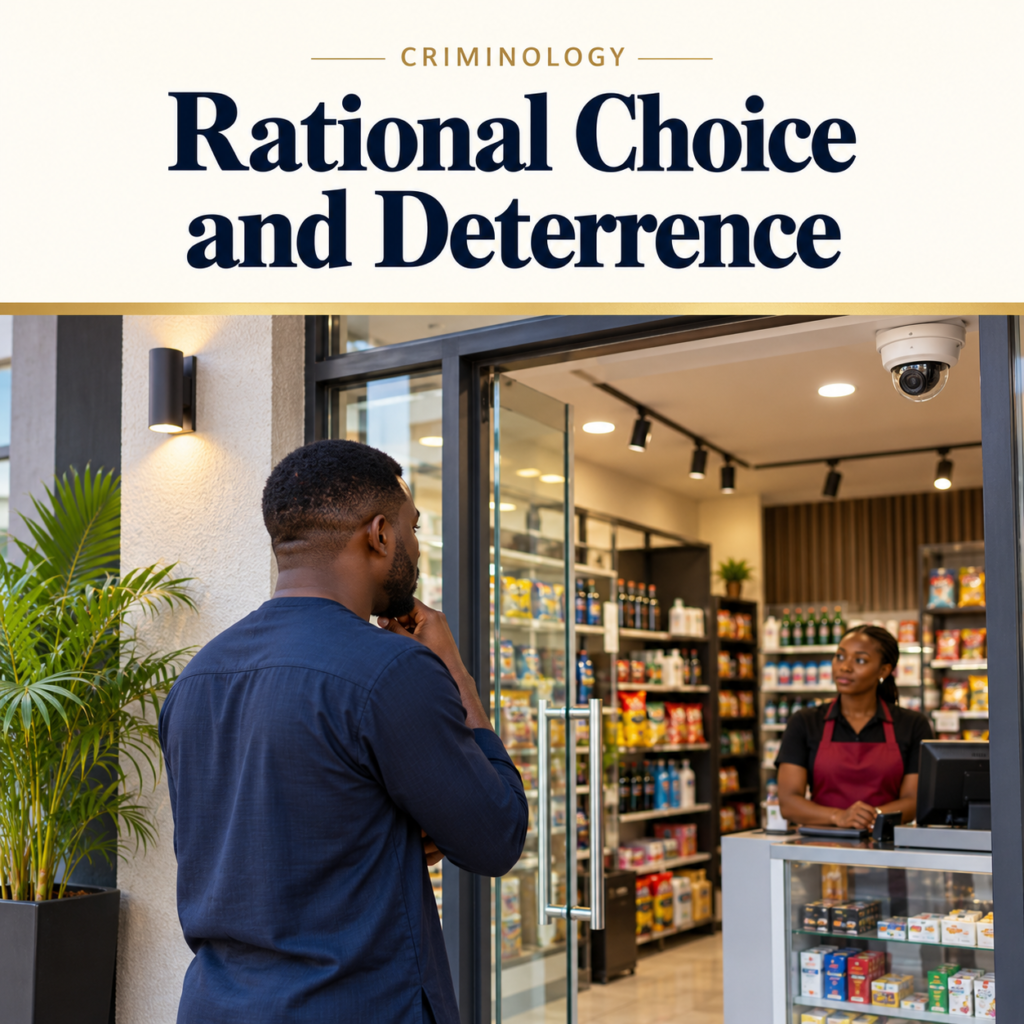
Rational Choice And Deterrence
An employee notices that nobody checks the expense claims.
He considers submitting a fake receipt: “I can collect ₦80,000. Who will find out?”
Then management introduces independent checks. Suddenly, the same employee becomes less confident.
The opportunity has changed—and so has his calculation.
→ RATIONAL CHOICE
This approach suggests that people sometimes weigh the expected benefits of crime against the risks and effort involved.
They may ask:
→ What will I gain?
→ How difficult will it be?
→ Will I get caught?
→ What could I lose?
But people do not always think carefully. Their decisions may be rushed, emotional or based on wrong information.
“Rational choice” does not mean the decision is sensible or morally right. It means the person sees some expected benefit in choosing it.
→ DETERRENCE
Deterrence means discouraging crime through the expectation of consequences.
→ General deterrence: Consequences imposed on one offender discourage others.
→ Specific deterrence: Consequences discourage that same person from offending again.
The likelihood of being caught generally matters more than simply threatening a harsher punishment.
A workplace can announce “instant dismissal for fraud” every morning. If nobody checks transactions, staff may still believe they can get away with it.
Practical deterrence requires:
→ Credible checks and oversight.
→ Clear rules and consequences.
→ Fair, consistent follow-through.
Deterrence has limits. Someone acting impulsively, under intense emotion or believing they cannot be caught may give little thought to consequences.

Social Learning And Peer Influence
On Tunde’s first week at work, a colleague tells him: “We add a little extra to transport claims. Everybody does it.”
Tunde hesitates. Then he watches the colleague collect the money, receive approval and face no questions.
Soon, he submits his own inflated claim.
He has learned more than a trick. He has learned that dishonesty is accepted and rewarded in that group.
→ SOCIAL LEARNING
This approach explains how people can learn criminal behaviour through interaction with others.
They may learn:
→ Methods: How the wrongdoing is carried out.
→ Attitudes: “There is nothing wrong with it.”
→ Excuses: “The company underpays us anyway.”
→ Expected rewards: Money, status or acceptance.
Learning can happen through observation, instruction and seeing what gets rewarded—or challenged.
→ PEER INFLUENCE
People around us can influence what we consider normal and which choices we make.
The pressure may be direct:
“Submit the claim. Stop acting better than us.”
Or subtle:
Everyone participates, and refusing means feeling excluded.
This happens among adults too. Colleagues, friends and professional networks can normalise wrongdoing.
But influence is not destiny. Tunde can still refuse, and knowing someone who commits crime does not make you a criminal.
The same learning process can support honest behaviour. When respected colleagues challenge false claims and managers reward integrity, newcomers learn a different standard.
Pay attention to what a group rewards. Its everyday behaviour may teach more than its written rules.

Strain And Social Control
Chika has worked for years, but her debts keep growing. Her friends appear successful. At work, she is passed over for promotion.
She feels trapped: “I am doing everything right. Why am I still struggling?”
Then someone offers her money to approve a false invoice.
Strain theory examines the pressure she feels. Social control theory asks what might hold her back from offending.
→ STRAIN THEORY
Strain refers to pressures and frustrations that can arise from blocked goals, significant losses or harmful experiences.
Examples include:
→ Being unable to achieve financial or social goals through legitimate means.
→ Losing a job or an important relationship.
→ Experiencing persistent mistreatment.
These experiences may produce anger, resentment or desperation. Some people respond through crime.
But pressure does not make crime inevitable. Others seek support, challenge unfair treatment or find lawful alternatives.
→ SOCIAL CONTROL THEORY
This approach asks: Why do people follow rules even when opportunities to offend exist?
It focuses on the bonds that connect people to others and to society:
→ Attachment: Caring about people whose trust you value.
→ Commitment: Having a career, education or reputation you do not want to jeopardise.
→ Involvement: Participating in meaningful, lawful activities.
→ Belief: Accepting that rules and obligations matter.
Chika may refuse because she values her integrity, her professional future and the trust of people close to her.
Having strong bonds does not guarantee honesty, and having weak bonds does not prove criminality.
In practice, prevention should address both sides: reduce harmful pressures and strengthen supportive relationships, legitimate opportunities and accountability.

Understanding Victims And Victimisation
Ngozi loses her business savings to a fraudster. Before anyone asks how she is coping, someone says: “How could you fall for that?”
Now she has lost her money—and feels ashamed to speak.
How people respond after a crime can deepen the harm.
→ WHO IS A VICTIM?
A person who suffers harm because of a crime. That harm may be physical, emotional, financial or involve damage to property.
People can also be affected indirectly: children who witness violence, families who lose a provider or employees whose livelihoods suffer after business fraud.
→ WHAT IS VICTIMISATION?
The experience or process of being harmed through crime.
It can involve a single incident or repeated targeting, such as ongoing abuse, harassment or exploitation.
VICTIMS DO NOT ALL REACT THE SAME WAY.
One person cries. Another becomes angry. Someone else appears calm, goes quiet or struggles to explain what happened.
Their immediate reaction alone does not prove or disprove their account.
→ SECONDARY VICTIMISATION
Additional harm caused by insensitive treatment after the original incident.
Examples include:
→ Blaming or mocking the person.
→ Unnecessarily making them repeat distressing details.
→ Sharing their story or images without permission.
→ Dismissing their concerns or treating them disrespectfully.
WHAT DOES A HELPFUL RESPONSE LOOK LIKE?
→ Check their immediate safety and urgent needs.
→ Listen calmly without blame or pressure.
→ Take their account seriously without declaring anyone guilty.
→ Explain available support and reporting options.
→ Respect their privacy and choices.
Discussing prevention can be useful. But the offender remains responsible for committing the crime. A victim’s trust, clothing or failure to anticipate danger does not transfer that responsibility.

Effects Of Crime On Individuals And Communities
Osas’s shop is burgled. People say: “At least nobody died.”
But the stolen stock was bought on credit. His assistant loses her job. School fees go unpaid. Weeks later, Osas still wakes at every sound outside.
The incident ended that night. Its effects did not.
→ PHYSICAL HARM
Crime can cause injuries, disability or loss of life. Families may also face the practical demands of caring for an injured person.
→ EMOTIONAL HARM
Fear, anger, shame and difficulty trusting others can continue long after the event. Some people struggle with sleep, concentration or returning to normal routines.
Reactions differ. You cannot measure someone’s suffering by how visibly upset they appear.
→ FINANCIAL HARM
The cost may include stolen money, repairs, treatment, lost earnings and time away from work.
For a small business, one incident can affect employees, suppliers and customers too.
→ DAMAGE TO RELATIONSHIPS
Victims may withdraw. Relatives may blame one another. Suspicion can divide colleagues and neighbours—especially when accusations spread without evidence.
→ COMMUNITY FEAR AND DISRUPTION
Repeated crime can make residents avoid public spaces, businesses close earlier and families restrict daily activities.
Fear can spread even among people who have not been directly targeted.
→ LOSS OF TRUST
When reports are ignored or people experience unfair treatment, confidence in institutions can weaken. Some stop reporting. Others may turn to dangerous retaliation or mob action.
What helps?
→ Practical support for those affected.
→ Fair, accessible reporting and responses.
→ Reliable information instead of rumours.
→ Prevention measures based on actual risks.
Replacing stolen property may address one loss. Recovery may also require restoring safety, income, relationships and trust.

The Criminal Justice System
A suspect is arrested, and someone announces: “They have caught the criminal.”
An arrest does not establish guilt.
A report must be examined. Evidence must be tested. The accused must have an opportunity to respond.
The criminal justice system is the network of institutions and processes through which society investigates alleged crimes, determines responsibility and carries out lawful outcomes.
Its main parts include:
→ POLICE AND OTHER INVESTIGATING AGENCIES
Receive reports, investigate allegations, gather evidence and identify suspects.
→ PROSECUTORS
Assess cases and present criminal charges in court where there is a basis to proceed.
→ COURTS
Hear the case, examine evidence and arguments, and determine whether the prosecution has proved the charge. If someone is convicted, the court determines the appropriate sentence.
→ CORRECTIONAL SERVICES
Carry out custodial sentences and support rehabilitation. Depending on the system, they may also supervise certain non-custodial measures.
→ DEFENCE LAWYERS AND LEGAL AID
Help accused persons understand and exercise their rights, challenge evidence and present their defence.
HOW DOES A CASE GENERALLY MOVE?
Report → Investigation → Decision on charges → Court proceedings → Outcome.
A conviction may be followed by sentencing, correctional measures and an appeal. Cases do not all follow an identical path, and not every report leads to prosecution.
Victims and witnesses also play important roles by providing accounts and evidence. They should be treated with dignity throughout the process.
The system must protect the public while treating people fairly. That includes taking victims seriously, respecting the presumption of innocence and requiring proof rather than public pressure.

Roles Of The Police, Courts And Correctional Services
A suspect is arrested. The crowd demands punishment immediately.
That crowd cannot replace an investigation or a court.
The police, courts and correctional services have different responsibilities. Understanding those boundaries helps us recognise both proper practice and abuse.
→ THE POLICE: PROTECT AND INVESTIGATE
Their responsibilities include:
→ Preventing and responding to crime.
→ Protecting people and maintaining public order.
→ Receiving complaints and investigating allegations.
→ Gathering and preserving evidence.
→ Making arrests where lawful grounds exist.
An investigation should examine evidence that points towards or away from a suspect.
The police do not determine guilt or impose a court sentence.
→ THE COURTS: HEAR AND DETERMINE
Courts hear evidence and legal arguments, protect fair proceedings and decide whether charges have been proved.
Where someone is convicted, the court determines the appropriate sentence within the law.
Suspicion, a viral video or public anger cannot replace proof.
→ CORRECTIONAL SERVICES: CUSTODY AND REHABILITATION
Their responsibilities include:
→ Holding people lawfully committed to their custody.
→ Maintaining safe and humane conditions.
→ Supporting education, skills development and rehabilitation.
→ Helping prepare people for reintegration into society.
Some people in custody are awaiting trial. Being held in a correctional facility does not automatically mean someone has been convicted.
Correctional services carry out lawful custody and sentences; they do not decide who is guilty.
These institutions must work together without abandoning their boundaries. An arrest starts a process—it does not settle the case.

Crime Prevention At Home And In The Community
The estate has a large gate, but the lock is broken. There are security lights, but nobody replaces the bulbs. Visitors enter because “somebody probably knows them.”
Security equipment cannot do its job when everyday routines undermine it.
Crime prevention means reducing opportunities for crime while building a community where people cooperate and report concerns responsibly.
→ SECURE ENTRY POINTS
Maintain doors, windows, gates and locks. Agree on how visitors and service providers will be verified before entry.
A uniform or familiar company name alone does not establish someone’s identity.
→ IMPROVE VISIBILITY
Keep entrances, paths and shared areas adequately lit. Address overgrown vegetation or obstructions that create concealed spots.
→ PROTECT INFORMATION
Avoid publicly sharing travel plans, access codes or details of valuables. Check who can view your social media updates.
→ BUILD RELIABLE NEIGHBOUR CONNECTIONS
Exchange trusted contact details and agree on how to raise an alarm. Check on neighbours who may need assistance.
Cooperation should support safety—not become an excuse to monitor people’s private lives.
→ REPORT SPECIFIC BEHAVIOUR
“Someone is trying several door handles” is useful information.
“He looks like a criminal” is an assumption.
Focus on actions and circumstances, not ethnicity, clothing, religion or social status.
→ ADDRESS REPEATED PROBLEMS
If theft keeps occurring near an unlit entrance, record the pattern and address the location, access arrangements and reporting gaps.
→ KEEP COMMUNITY ACTION SAFE
Do not chase, beat or publicly parade suspected offenders. Move to safety and seek appropriate assistance.
These measures can reduce risk; they cannot guarantee that crime will never happen. Responsibility for an offence remains with the person who commits it.

Workplace Crime Prevention
“Only Mrs Bello handles the payments. We trust her.”
Trust matters. But what happens when Mrs Bello makes a mistake, someone uses her account, or a dishonest transaction slips through?
Good controls protect honest employees as well as the organisation.
Workplace crime prevention means reducing opportunities for theft, fraud, violence and other offences through clear procedures and consistent oversight.
→ SEPARATE KEY RESPONSIBILITIES
Avoid giving one person complete control over requesting, approving, paying and checking the same transaction.
Independent review makes errors and wrongdoing easier to detect.
→ CONTROL ACCESS
Limit access to cash, stock, records and computer systems according to each person’s duties.
Use individual accounts. Remove access promptly when staff leave or change roles.
→ VERIFY BEFORE PAYING
Confirm unusual payment requests and changes to supplier bank details through a trusted, independent contact method.
“The director said it is urgent” is not a reason to skip checks.
→ CHECK RECORDS REGULARLY
Compare stock counts, receipts, invoices and bank records. Investigate unexplained differences without immediately accusing someone.
→ MANAGE VISITORS AND ASSETS
Verify visitors, supervise access to restricted areas and record the movement of valuable equipment.
→ MAKE REPORTING POSSIBLE
Provide a clear route for reporting suspected wrongdoing, threats or intimidation—including concerns involving a manager.
Handle reports discreetly and protect people from retaliation.
→ TAKE THREATS SERIOUSLY
Respond promptly to threats, harassment and escalating aggression. Staff should know how to seek help and move to safety.
Managers must follow the same controls they expect staff to follow. A procedure that powerful people can bypass is a weakness waiting to be exploited.

Reporting Crime And Recording Observations
“I saw Gbenga steal the laptop.”
What did you actually see?
“I saw him leave the office carrying a black bag. Later, we noticed the laptop was missing.”
Those are different statements. The first alleges theft. The second describes an observation.
A useful report separates what you witnessed, what someone told you and what you suspect.
→ PUT SAFETY FIRST
If danger is ongoing, move to safety and seek urgent assistance. Do not confront someone or follow them to gather more details.
→ REPORT THROUGH THE APPROPRIATE CHANNEL
Contact the police or relevant investigating agency. At work, also follow the organisation’s reporting procedure where appropriate.
An internal report should not delay urgent help.
→ RECORD DETAILS PROMPTLY
As soon as it is safe, note:
→ The date, time and location.
→ What happened, in sequence.
→ What you personally saw or heard.
→ Relevant descriptions, vehicles or direction of movement.
→ Any witnesses or potential evidence.
→ BE PRECISE ABOUT UNCERTAINTY
If the time is approximate, say so. If you did not see a face clearly, record that.
“I do not know” is more useful than an invented detail.
→ KEEP WORDS AND INTERPRETATIONS SEPARATE
Write “He said, ‘I will hurt you’” if those were his exact words.
If you only remember the general meaning, describe it without pretending it is an exact quotation.
→ PROTECT THE ORIGINAL ACCOUNT
Keep your original notes. Clearly date any later additions or corrections. Give your own account before comparing recollections with others.
→ SHARE RESPONSIBLY
Provide information to those handling the matter. Avoid posting accusations, witness details or distressing images in public groups.
Your role is to report accurately. Investigators must establish what the observations mean.
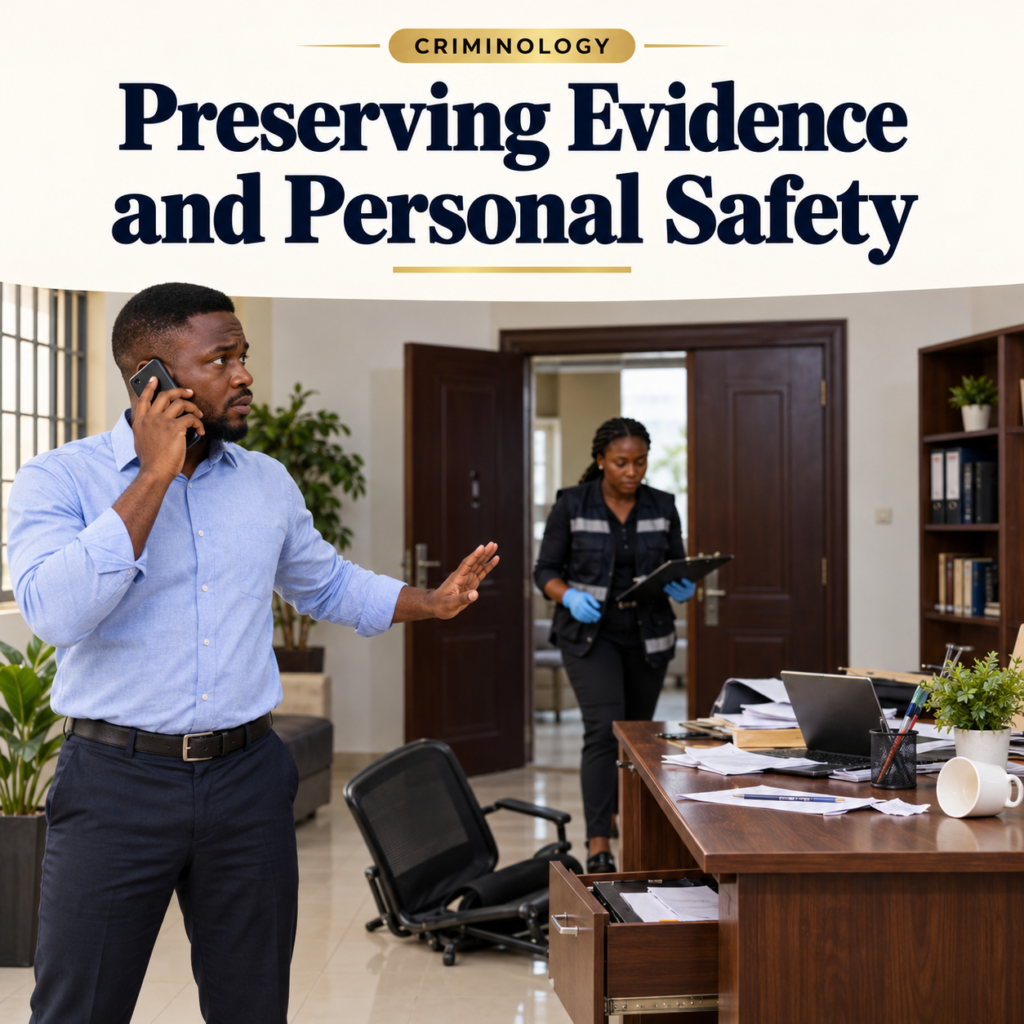
Preserving Evidence And Personal Safety
Bisi discovers a broken office door. She picks up a metal tool, rearranges the scattered files and wipes the desk before calling for help.
She meant well. But she may have disturbed fingerprints, moved important items and changed the scene.
Helping starts with knowing what to leave alone.
Evidence can include objects, documents, messages, recordings and other information that helps establish what happened.
→ SAFETY COMES FIRST
Do not enter an unsafe area, confront a suspect or touch weapons, suspicious substances or exposed electrical equipment.
Move to safety and seek assistance. Saving a life takes priority over preserving a scene.
→ LEAVE ITEMS AS YOU FOUND THEM
Avoid touching, cleaning, moving or testing potential evidence. Do not open drawers or search the area out of curiosity.
Leave collection to trained personnel.
→ LIMIT UNNECESSARY ACCESS
From a safe position, discourage people from entering or handling items while help is on the way.
Do not put yourself at risk trying to control others.
→ RECORD WITHOUT DISTURBING
Note what you observed, when you discovered it and who entered the area.
Only take photographs if it is safe and appropriate. Do not move objects to get a clearer picture.
→ PROTECT DIGITAL MATERIAL
Keep original messages, emails, files and transaction records. Do not delete, edit or rely only on forwarded copies.
Screenshots may help, but they may omit important information. Preserve the original source and seek specialist guidance before examining a device.
→ RECORD ANY NECESSARY CHANGES
If something was moved to help an injured person or remove an immediate danger, explain exactly what changed, who changed it and why.
→ KEEP HANDOVERS TRACEABLE
If an item is already in your possession, minimise handling and record whom you give it to and when.
This supports the chain of custody: the documented history of an item’s possession and handling.
You do not need to solve the case at the scene. Protect yourself, avoid unnecessary interference and give an accurate account.

Ethics, Human Rights And Avoiding Profiling
A phone goes missing. Someone points at the newest cleaner: “Check him. You know how these people are.”
No witness. No evidence. Just his job, appearance and background.
That is prejudice steering an accusation.
→ ETHICS: DOING THE RIGHT THING
Ethics means acting honestly, fairly and responsibly—even when you are under pressure.
→ Record facts accurately.
→ Acknowledge what you do not know.
→ Examine information that challenges your assumptions.
→ Disclose personal interests that could affect your judgement.
→ Never invent, hide or alter evidence.
→ HUMAN RIGHTS: DIGNITY DOES NOT DISAPPEAR UNDER SUSPICION
Victims, witnesses and suspects all deserve respectful treatment.
An allegation does not justify threats, humiliation, violence or forcing someone to confess.
Taking a complaint seriously and treating the accused fairly can happen together.
→ AVOIDING PROFILING
Do not treat ethnicity, religion, poverty, clothing, disability or occupation as proof of criminal behaviour.
Focus on specific actions and relevant evidence.
“He was trying several locked doors” describes behaviour.
“He looks like a thief” expresses an assumption.
A description from a witness can help identify someone, but matching a description alone does not establish guilt.
→ PROTECT PRIVACY
Share sensitive information only with people who need it for an appropriate purpose. Avoid circulating suspects’ photographs or victims’ personal details in public groups.
→ CHECK YOUR OWN BIAS
Before drawing a conclusion, ask:
→ What evidence supports this?
→ What other explanation could fit?
→ Would I judge this differently if the person were wealthy, familiar or from my own community?
Fairness strengthens an investigation. Once you decide who is guilty before examining the facts, you risk overlooking the truth.
Today’s Review And Final Word
We started with a simple question: What is criminology?
By now, you should see why studying crime requires more than identifying a suspect and demanding punishment.
Today, we examined:
→ Crime, deviance and misconduct—different concepts that can overlap.
→ Types of crime—including violent, property, financial, cyber and organised crime.
→ Why people offend—how choices, opportunities, pressure, learning and social bonds can influence behaviour.
→ Victims and communities—how harm continues beyond the incident, and how blame can deepen it.
→ The criminal justice system—the distinct responsibilities of the police, courts and correctional services.
→ Prevention—practical controls at home, at work and in the community.
→ Responsible reporting—separating observations from assumptions.
→ Evidence and safety—protecting yourself while avoiding unnecessary interference.
→ Ethics and human rights—treating people fairly and following evidence.
MY FINAL WORD
After this class, be more careful with the sentence: “I know who did it.”
Ask yourself: What do I actually know? What did I observe? What still needs to be established?
Do not let anger turn suspicion into certainty. Do not let someone’s appearance replace evidence. And do not let the desire to help put you—or someone else—in danger.
The value of this knowledge is in how you use it: to prevent harm, support people and make better decisions.
Thank you for learning with us.
Tomorrow, we move into Forensic and Fraud Investigation—examining how evidence helps establish what happened.