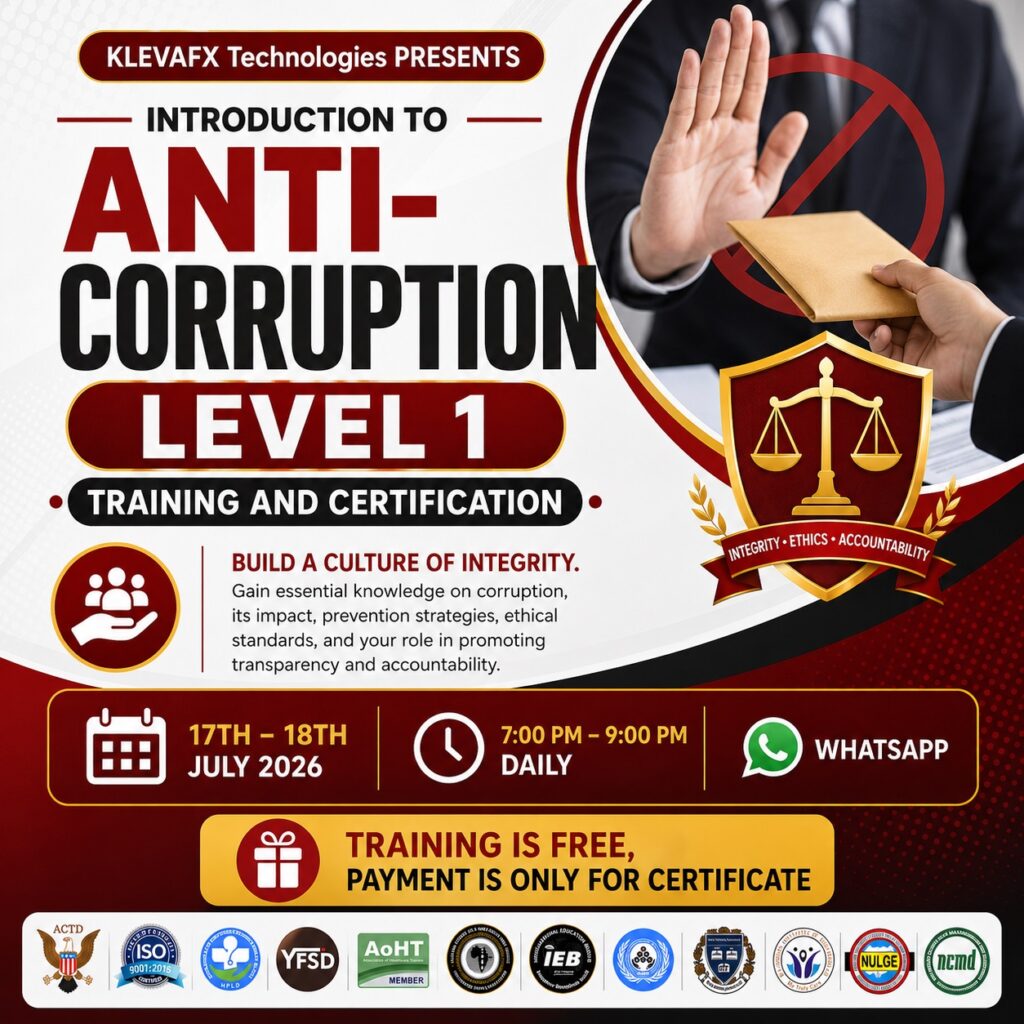

WELCOME, INTRODUCTIONS & COURSE OBJECTIVES
Good evening everyone, and welcome to Introduction to Anti-Corruption (Level 1).
For the next two days, I want you to forget everything you think you know about corruption.
This is not just another certificate course.
This training is designed to change the way you think, make decisions, and respond to corruption in your workplace, your business, and your everyday life.
Corruption is not only about politicians.
It happens in offices.
It happens in schools.
It happens in hospitals.
It happens in procurement.
It happens in recruitment.
It happens in businesses.
It even happens in our homes and communities.
By the end of this training, you should be able to:
- Understand what corruption really is.
- Recognize corruption in its many forms.
- Identify corruption risks around you.
- Make ethical decisions under pressure.
- Know how corruption can be prevented.
- Understand your personal responsibility in fighting corruption.
This is an interactive class.
Ask questions.
Share experiences.
Challenge ideas respectfully.
Participate actively.
The more you contribute, the more you will learn.

It was 4:45 p.m. on a Friday.
The offices at the Federal Ministry of Works in Abuja were gradually emptying as civil servants prepared for the weekend.
Inside the Procurement Department, Emeka Chukwuemeka Nwosu, a Procurement Officer with just two years in public service, was reviewing a contract worth ₦185 million for the supply of road maintenance equipment.
He had already checked the evaluation report when something unusual caught his attention.
Three companies had supposedly competed for the contract.
Different names.
Different logos.
Different addresses.
Yet all three quotations contained identical formatting, the same grammatical mistakes, identical pricing down to the last naira, and two of the companies even shared the same contact phone number.
Emeka frowned.
“This can’t be a coincidence,” he murmured.
Just then, his supervisor, Hauwa Suleiman, entered.
“Emeka, have you finished with that file?”
“Almost, ma.”
“The Permanent Secretary wants it signed before everyone leaves.”
Emeka hesitated.
“Ma… there are serious inconsistencies in these quotations.”
She looked at the file for only a few seconds before closing it.
“Emeka…”
“You are still learning.”
“Sometimes, if you investigate every little thing, nothing gets done.”
“But ma, this could mean the bidding process wasn’t genuine.”
She lowered her voice.
“Just process it.”
A few minutes later, Emeka’s phone rang.
It was Kunle Adewale Ogunleye from Finance.
“My brother, we’re waiting for your approval.”
“I’ve not finished my review.”
Kunle laughed.
“You worry too much.”
“Everyone has already signed.”
“Don’t be the only person slowing things down.”
Before Emeka could continue reviewing the documents, his secretary informed him that someone wanted to see him.
It was Ifeanyi Chibuzor Okeke, Managing Director of PrimeBuild Nigeria Ltd.
The contractor smiled warmly.
“Good evening, Officer.”
“I heard you’re handling our file.”
He placed a black envelope on the table.
“I know you’ve worked very hard.”
“This is just appreciation.”
Emeka stared at the envelope.
“I can’t accept this.”
The contractor smiled again.
“It’s not a bribe.”
“It’s simply gratitude.”
“You have a family.”
“We all need to survive.”
Emeka slowly pushed the envelope back.
“No, sir.”
“I cannot.”
As the contractor picked up the envelope, Fatima Zainab Musa, the Internal Auditor, happened to walk past the office.
Through the slightly open door, she noticed the contractor leaving with an envelope while Emeka remained seated with the procurement file open.
She didn’t interrupt.
She simply made a mental note.
That evening, everyone left the office.
Everyone except Emeka.
He stayed behind, reviewing every page again.
The more he read, the more uncomfortable he became.
Finally, he prepared a formal memo.
He documented every inconsistency he had discovered.
He attached copies of the quotations.
He recommended that the procurement process be suspended pending further investigation.
Before leaving, he submitted the memo directly to the office of the Permanent Secretary.
Monday morning.
The atmosphere in the ministry was unusually tense.
Instead of approving the contract, the Permanent Secretary, Abdulrahman Sani Yusuf, called an emergency management meeting.
Everyone connected to the procurement process was invited.
The Internal Auditor was instructed to conduct an independent review.
Within three days, the investigation uncovered shocking findings.
The three bidding companies were secretly owned by the same group of individuals.
Two addresses were fake.
One company had never supplied road equipment before.
Several documents had been forged.
An employee in Procurement had leaked confidential bid information.
A Finance officer had already prepared payment vouchers before the procurement process was complete.
The contractor had attempted to influence public officials with cash.
The entire procurement exercise had been carefully arranged to make a predetermined winner appear legitimate.
The consequences were immediate.
The procurement process was cancelled.
The contractor was suspended from participating in future government contracts pending further investigation.
Disciplinary proceedings began against several public officers.
The matter was referred to the appropriate anti-corruption agency.
Millions of naira in public funds were protected from being misused.
A week later, Emeka was invited to the Permanent Secretary’s office.
He wondered if he was in trouble.
Instead, the Permanent Secretary stood up and shook his hand.
“You know, many people think integrity means never making mistakes.”
“It doesn’t.”
“Integrity means doing the right thing when everyone else expects you not to.”
He continued,
“You were pressured.”
“You were offered money.”
“You were told everybody had already signed.”
“You still chose the law over convenience.”
“That is the kind of public servant Nigeria needs.”
As Emeka walked back to his office, several colleagues looked at him differently.
Some admired him.
Some thought he had made powerful enemies.
Some believed he had been foolish to reject “free money.”
But Emeka understood something many people never do.
Corruption rarely begins with millions of naira.
It begins with one ignored red flag.
One false signature.
One “small appreciation.”
One decision to look away.
And financial integrity begins the same way—
With one person choosing to do what is right, even when it is difficult.
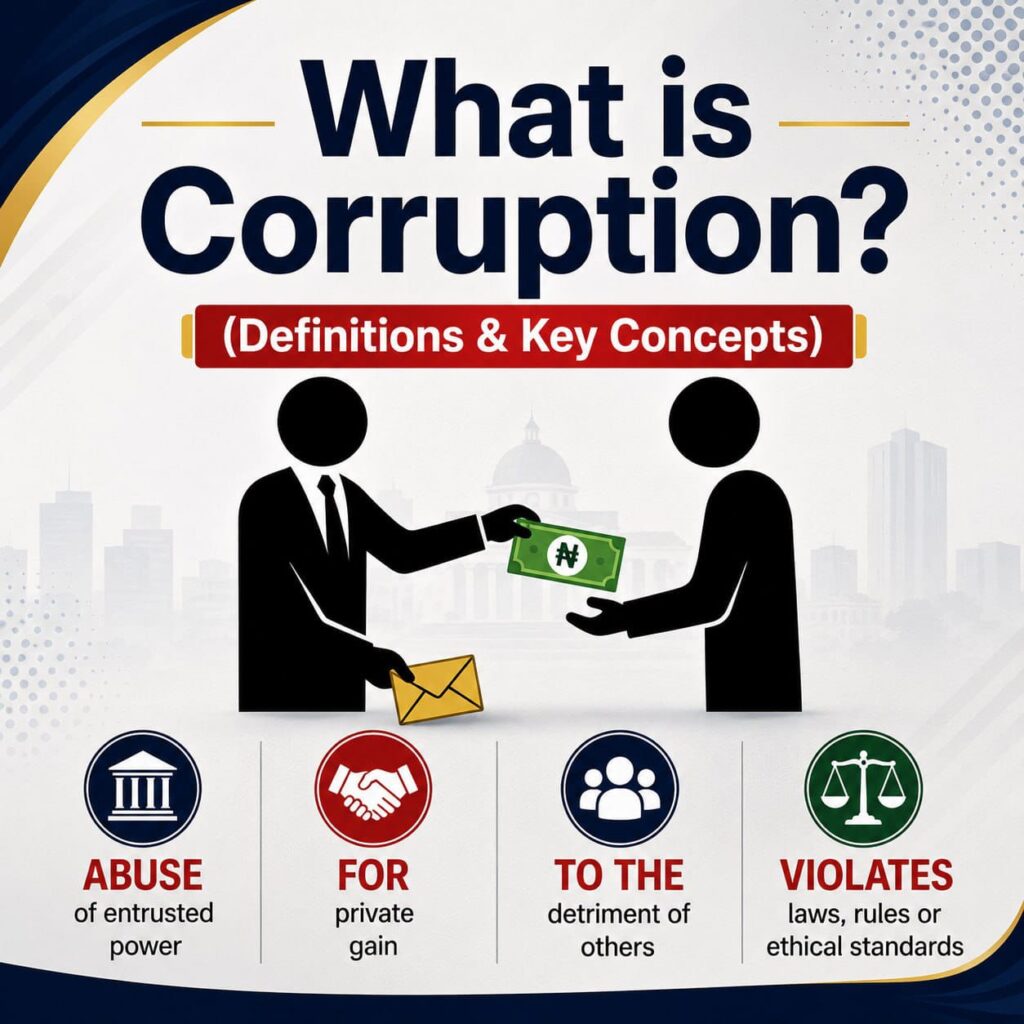
ABUSE OF OFFICE, NEPOTISM, CRONYISM & CONFLICT OF INTEREST
You don’t have to steal money to be corrupt.
Every day, people destroy careers, deny opportunities, and abuse public trust without taking a single naira into their pockets.
One signature.
One phone call.
One favour for a relative.
One decision based on friendship instead of merit.
That is corruption.
Not all corruption involves exchanging money.
Some of the most damaging forms of corruption occur when people misuse the power entrusted to them.
- ABUSE OF OFFICE
Abuse of office is using the authority of your position for personal gain or to unfairly benefit another person.
People are given authority to serve—not to intimidate, manipulate, or enrich themselves.
Example:
A government official awards contracts to companies he secretly owns.
A supervisor promotes an employee because they perform personal errands for him.
A manager uses official vehicles, staff, or office funds for private business.
The higher the office, the greater the responsibility—not the greater the privilege.
- NEPOTISM
Nepotism is giving unfair advantage to family members or relatives, regardless of whether they are the most qualified.
Every appointment should be based on competence, merit, and fairness—not bloodline.
Example:
A university administrator ensures his daughter is employed ahead of candidates with better qualifications.
A company owner recruits siblings and cousins while ignoring more competent applicants.
When merit dies, organizations begin to fail.
- CRONYISM
Cronyism is favoring friends, political associates, loyal supporters, or close acquaintances instead of selecting the most qualified person.
Unlike nepotism, which involves family, cronyism involves friends and trusted allies.
Example:
A procurement committee repeatedly awards contracts to the chairman’s close friends without following competitive bidding procedures.
A senior executive promotes only those who belong to his inner circle.
Friendship is not a qualification.
- CONFLICT OF INTEREST
A conflict of interest exists when your personal interests have the potential to influence your professional decisions.
Having a conflict of interest is not always misconduct.
Failing to declare or manage it is.
Example:
A procurement officer evaluates bids submitted by a company owned by his spouse.
A board member votes to award a contract to a business in which he owns shares.
The ethical response is simple:
Declare the conflict.
Step aside from the decision.
Protect the integrity of the process.
Remember this.
Abuse of office misuses authority.
Nepotism favors family.
Cronyism favors friends.
Conflict of interest threatens impartiality.
Integrity is not tested when doing the right thing is easy.
Integrity is tested when you have the power to benefit yourself—and choose not to.
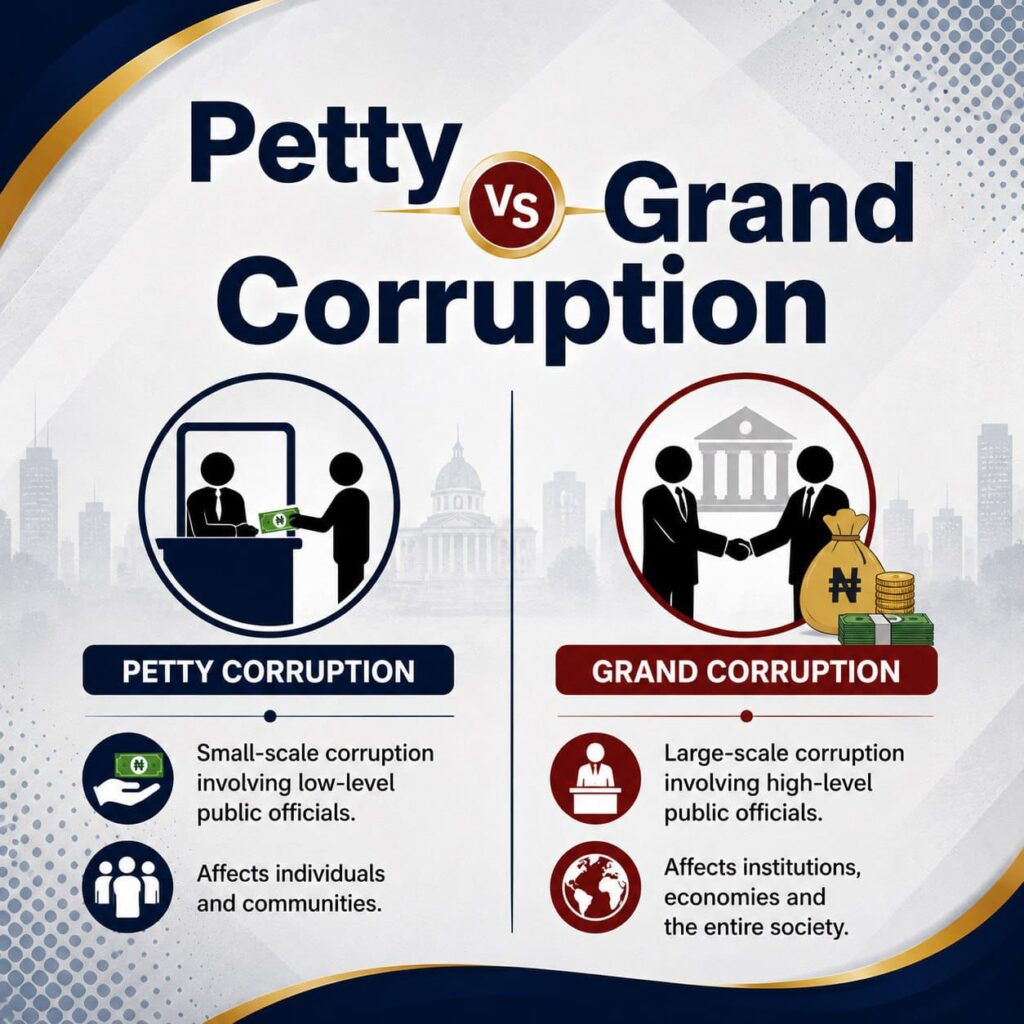
PETTY VS GRAND CORRUPTION
There is no such thing as “small” corruption.
The amount of money may differ.
The damage to society does not.
Many people excuse petty corruption by saying:
“It’s only ₦2,000.”
“Everybody does it.”
“It’s just appreciation.”
“Nothing will happen if I collect it.”
That is how corruption becomes a culture.
Corruption is generally divided into two categories: petty corruption and grand corruption.
- PETTY CORRUPTION
Petty corruption involves small-scale abuses of power that occur during everyday interactions between the public and officials or employees.
Although each act may involve a small amount, it happens frequently and affects millions of people.
Examples:
- A public officer demands “something for the weekend” before processing a legitimate document.
- A police officer requests cash instead of issuing a lawful fine.
- A hospital worker asks for unofficial payment before attending to a patient.
- An employee accepts a gift in exchange for speeding up a routine process.
Petty corruption steals dignity one victim at a time.
- GRAND CORRUPTION
Grand corruption occurs at the highest levels of government, business, or public institutions.
It usually involves large sums of money, influential individuals, and decisions that affect entire communities or nations.
Examples:
- Inflating the value of government contracts.
- Diverting public funds meant for healthcare, education, or infrastructure.
- Rigging major procurement processes.
- Approving projects for personal financial gain.
Grand corruption steals the future of a nation.
Schools remain unfinished.
Hospitals lack equipment.
Roads collapse.
Businesses lose confidence.
Citizens lose hope.
The Difference
Petty corruption affects individuals every day.
Grand corruption affects generations.
Both are abuses of entrusted power.
Both are unethical.
Both are illegal.
Never justify corruption because it is “small.”
Every major corruption scandal began with someone believing that one dishonest act would never
matter.

PUBLIC SECTOR VS PRIVATE SECTOR CORRUPTION
Corruption is not a government problem.
It is a people problem.
Whenever honesty is replaced by greed, corruption follows—whether the organization is public or private.
Many people are quick to criticize government corruption while ignoring the same dishonest practices in businesses, banks, schools, NGOs, hospitals, and private companies.
Corruption has no preferred employer.
It exists wherever people are willing to abuse trust for personal gain.
- PUBLIC SECTOR CORRUPTION
Public sector corruption occurs when government officials or public servants abuse their positions for personal benefit.
The victims are usually the citizens.
Every naira stolen from public funds is money taken from schools, hospitals, roads, security, and essential public services.
Examples:
- Awarding government contracts in exchange for kickbacks.
- Demanding unofficial payments before providing public services.
- Diverting government funds for personal use.
- Recruiting staff based on political influence rather than merit.
- Manipulating procurement processes to favour selected contractors.
Public office is a public trust—not a personal business.
- PRIVATE SECTOR CORRUPTION
Private sector corruption occurs when employees, managers, directors, suppliers, or business owners engage in dishonest practices for personal or corporate gain.
The victims include customers, investors, employees, shareholders, and business partners.
Examples:
- Paying bribes to secure contracts.
- Falsifying financial records to deceive investors.
- Paying or receiving kickbacks from suppliers.
- Stealing company assets or funds.
- Manipulating recruitment, promotions, or procurement decisions.
- Sharing confidential business information for personal profit.
A dishonest company may make money today but destroy its reputation tomorrow.
The Difference
Public sector corruption weakens government and damages national development.
Private sector corruption destroys businesses, jobs, investor confidence, and economic growth.
The Similarity
Both involve the abuse of trust.
Both undermine fairness, accountability, and integrity.
Both have serious legal, financial, and reputational consequences.
Corruption does not care where you work.
Whether you serve the public or the private sector, your integrity is your greatest professional asset.
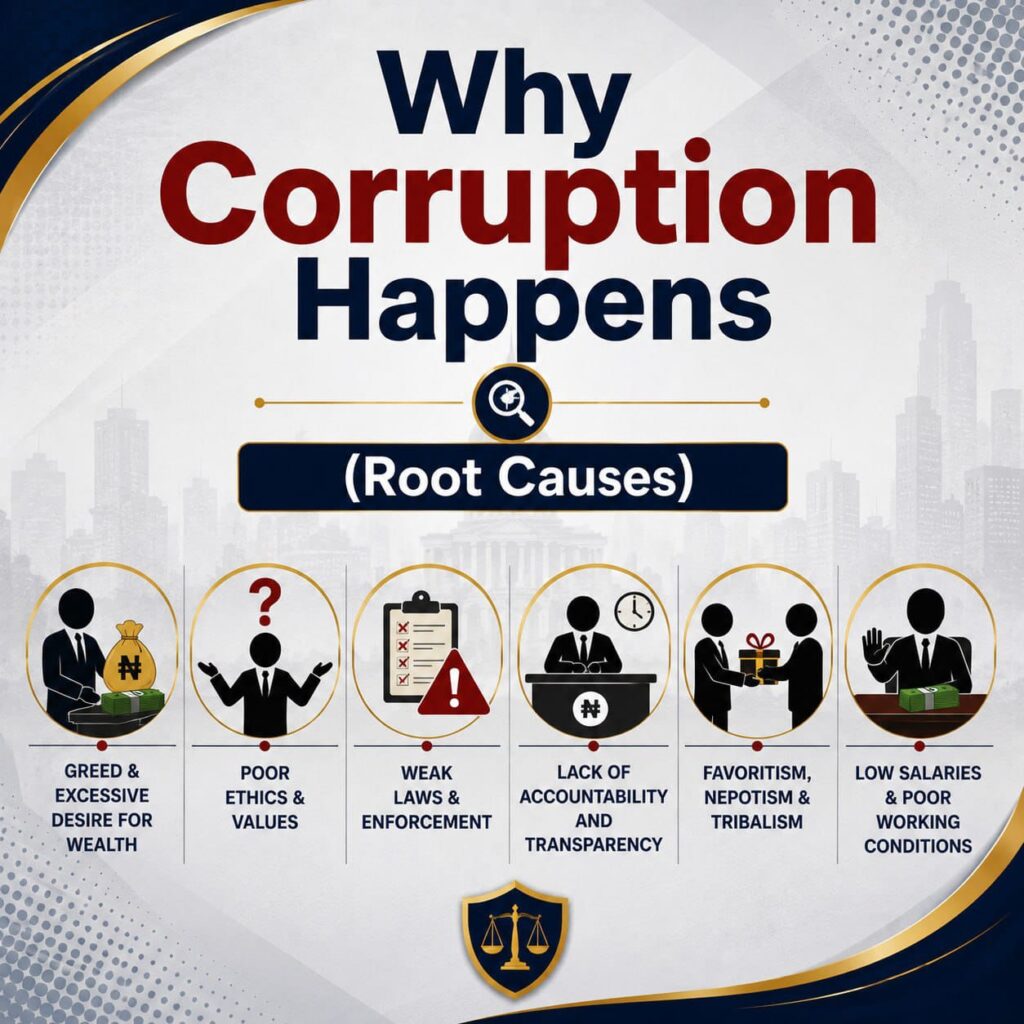
WHY CORRUPTION HAPPENS (ROOT CAUSES)
People are not born corrupt.
Nobody enters the workforce dreaming of taking bribes, manipulating contracts, or abusing public trust.
So why do honest people become dishonest?
Because corruption is rarely a single decision.
It usually begins with one excuse.
“Everyone else is doing it.”
“Nobody will know.”
“I deserve it.”
“It’s just this once.”
That is where corruption starts.
The root causes of corruption are deeper than money.
- GREED
Some people already have enough—but they always want more.
Greed has no finish line.
It turns positions of trust into opportunities for personal enrichment.
When greed becomes stronger than integrity, corruption follows.
- WEAK ETHICAL VALUES
Many people know what is right.
They simply choose what benefits them.
Without honesty, self-discipline, and accountability, rules become meaningless.
Character is the first line of defence against corruption.
- LACK OF ACCOUNTABILITY
Corruption thrives where nobody is watching.
Weak supervision.
Poor audits.
No consequences.
When people believe they will never be caught, corruption becomes easier.
Certainty of punishment discourages corruption more than the severity of punishment.
- ABUSE OF POWER
Power without accountability is dangerous.
Some people begin to believe that their position places them above policies, procedures, and even the law.
No one is above accountability.
- POVERTY AND FINANCIAL PRESSURE
Financial hardship can tempt people to make poor decisions.
But poverty does not automatically create corruption.
Millions of honest people struggle financially every day without compromising their integrity.
Pressure may explain corruption.
It never justifies it.
- ORGANIZATIONAL CULTURE
When corruption becomes “the way things are done,” honest employees face enormous pressure to conform.
New staff quickly learn that promotions, contracts, and opportunities may depend on loyalty instead of merit.
A corrupt culture can influence good people.
A strong culture of integrity can also inspire them.
- LACK OF TRANSPARENCY
Secret decisions create opportunities for corruption.
Transparent recruitment.
Transparent procurement.
Transparent financial reporting.
Transparent decision-making.
These reduce opportunities for abuse.
Remember this.
Corruption does not begin with stolen millions.
It begins when integrity is replaced by excuses.
Every act of corruption starts with a decision.
Every act of integrity starts with one too.
Grace Olufunke Akinyemi had just been promoted to Procurement Manager at Sunrise State University Teaching Hospital in Ibadan.
She was excited.
For eight years, she had built a reputation for honesty, professionalism, and attention to detail.
Her colleagues often joked that she was “too strict” because she insisted on following procurement procedures exactly as they were written.
On her first week in her new position, the hospital announced plans to purchase new laboratory equipment worth over ₦300 million.
Several reputable companies submitted bids.
Everything appeared to be going smoothly until Grace was invited into the office of the hospital’s Director of Administration, Mr. Bala Ibrahim Garba.
After exchanging pleasantries, he slid one of the bidding documents across the table.
“This is the company we want,” he said calmly.
Grace looked at the evaluation report.
“Sir, they were ranked fourth.”
Mr. Garba smiled.
“That doesn’t matter.”
“They’re our people.”
Grace remained silent.
The Director leaned back in his chair.
“You’ll understand how things work here soon.”
As she walked back to her office, a senior colleague quietly caught up with her.
“My sister,” he whispered, “don’t stress yourself.”
“This is how procurement has always been done.”
“Everybody cooperates.”
“If you refuse, they’ll simply replace you.”
That evening, Grace discussed the situation with her husband.
He had recently lost his job.
Their landlord had already issued a final notice for unpaid rent.
Their eldest daughter had been sent home from school because school fees were outstanding.
Her husband sighed.
“Maybe this is one of those times you should just sign.”
“It’s not as if the money is coming into your own account.”
“You have to think about this family too.”
Grace hardly slept that night.
The next morning, she discovered that the procurement file had already been signed by several senior officers.
Only her signature was missing.
A few hours later, one of the contractors requested a private meeting.
After exchanging greetings, he placed a gift bag on her desk.
Inside was a brand-new smartphone and an envelope containing cash.
He smiled.
“Madam, congratulations on your promotion.”
“We’re only showing appreciation.”
“You’ll find that everyone benefits when we work together.”
Grace immediately returned the gift.
The contractor laughed.
“You’ll change your mind.”
“Everyone does.”
As the days passed, the pressure increased.
Some colleagues stopped speaking to her.
Others warned her she was becoming “too difficult.”
One officer even told her,
“In this organization, integrity doesn’t pay your bills.”
Grace sat alone in her office staring at the procurement file.
She realized this situation was no longer just about one contract.
It was about something much bigger.
She saw greed in those seeking personal gain.
She saw weak ethical values in people who knew the right thing but ignored it.
She saw a lack of accountability because everyone believed nobody would question the process.
She saw abuse of power from senior officials trying to influence procurement decisions.
She felt the weight of financial pressure in her own home.
She witnessed an organizational culture where corruption had become normal.
She noticed the absence of transparency, with decisions being made behind closed doors.
For the first time in her career, Grace understood that corruption rarely begins with someone stealing millions of naira.
It begins with ordinary people accepting ordinary excuses.
She picked up her pen.
She had a decision to make.
Would she become part of the culture…
Or become the person who begins to change it?
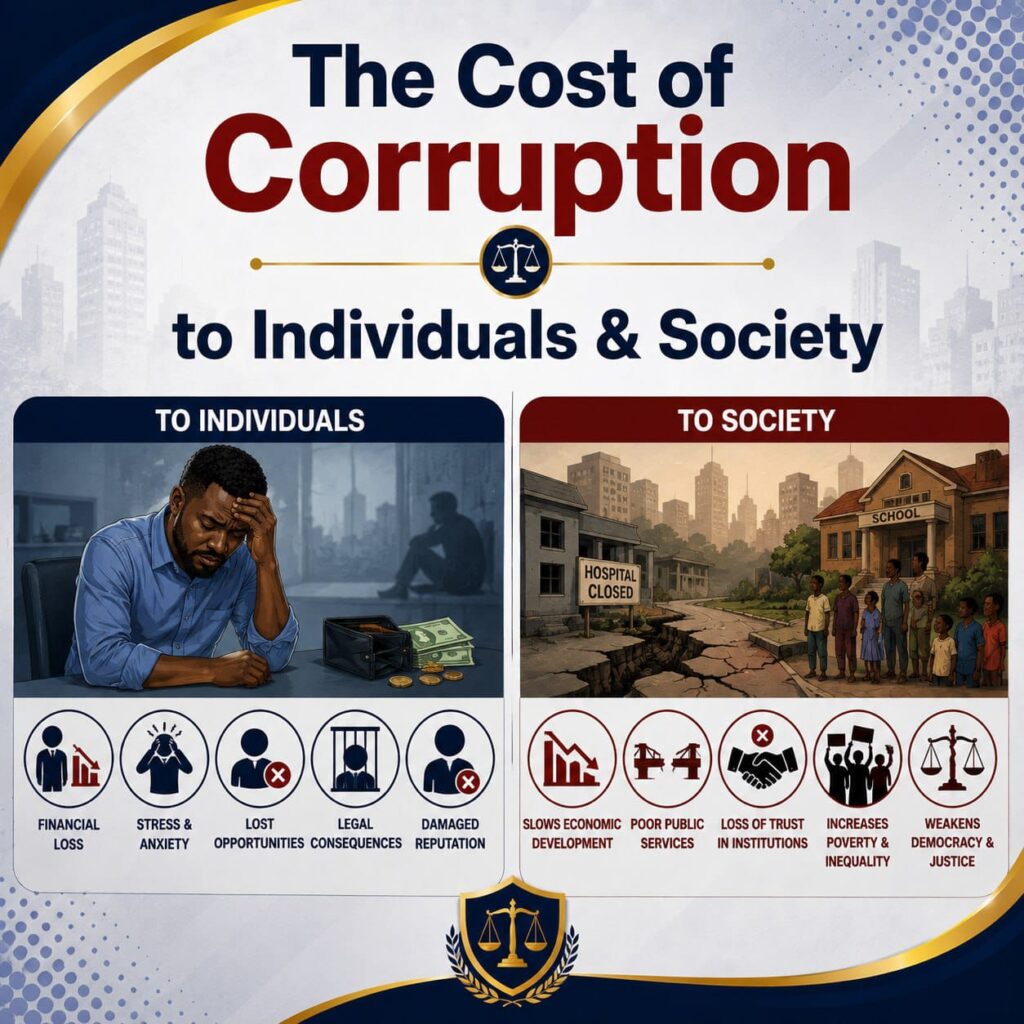
THE COST OF CORRUPTION TO INDIVIDUALS & SOCIETY
Corruption is not a victimless crime.
Every bribe paid.
Every contract inflated.
Every public fund stolen.
Every dishonest decision.
Someone pays the price.
The tragedy is that the people who suffer most are often those who had nothing to do with the corruption.
- IT DESTROYS LIVES
When money meant for hospitals is stolen, patients die from preventable illnesses.
When education funds disappear, children are left with overcrowded classrooms, poor facilities, and limited opportunities.
When roads are built with substandard materials because of kickbacks, accidents claim innocent lives.
Corruption kills—sometimes silently.
- IT KEEPS PEOPLE IN POVERTY
Money intended to improve communities is diverted into private pockets.
Communities remain without clean water.
Electricity projects are abandoned.
Youth remain unemployed.
Families continue to struggle.
Corruption steals opportunities before they are even created.
- IT DESTROYS TRUST
When people no longer trust public institutions, businesses, or leaders, confidence begins to disappear.
Citizens become cynical.
Employees lose motivation.
Investors take their money elsewhere.
A society without trust cannot grow sustainably.
Trust takes years to build and seconds to destroy.
- IT DAMAGES THE ECONOMY
Corruption discourages investment.
It increases the cost of doing business.
It rewards dishonesty instead of innovation and hard work.
Businesses become less competitive.
Economic growth slows.
Jobs disappear.
No economy prospers where corruption becomes the norm.
- IT REWARDS THE WRONG PEOPLE
Hard work is ignored.
Merit is overlooked.
Competence is replaced by connections.
Honest people become frustrated while dishonest people appear to succeed.
Over time, excellence is replaced by mediocrity.
When corruption is rewarded, integrity becomes expensive.
- IT DAMAGES YOUR PERSONAL REPUTATION
A single corrupt act can erase years of credibility.
You may recover stolen money.
You may regain your position.
But rebuilding trust is far more difficult.
Your reputation is one of your most valuable assets.
Protect it.
Remember this.
Corruption is never just about money.
It steals hope.
It steals justice.
It steals opportunity.
It steals development.
And in the worst cases…
It steals lives.

CORRUPTION AROUND US
The most dangerous corruption is the corruption people no longer recognize.
When dishonesty becomes common, people stop questioning it.
They stop calling it corruption.
Instead, they give it new names.
“It’s normal.”
“That’s how the system works.”
“Nothing will change.”
“Just settle them and move on.”
Corruption survives because society slowly becomes comfortable with it.
Think about everyday situations people often dismiss:
- Paying someone to jump a queue.
- Offering money to avoid a traffic offence.
- Receiving “commission” for influencing a purchasing decision.
- Hiring relatives instead of the best candidates.
- Claiming allowances for trips that never happened.
- Using office vehicles, equipment, or staff for personal business.
- Altering attendance records or timesheets.
- Leaking confidential information for personal gain.
- Accepting expensive gifts from suppliers before awarding contracts.
- Falsifying qualifications or work experience to secure employment.
Many of these acts are dismissed as “smartness” or “survival.”
They are neither.
They are abuses of trust.
And every time they are tolerated, they become more deeply rooted in our organizations and communities.
One dishonest act rarely remains isolated.
It encourages another.
Then another.
Eventually, corruption becomes the expected way of doing business.
Changing a nation begins with changing what we are willing to accept.
The fight against corruption starts long before a courtroom.
It starts the moment ordinary people refuse to normalize dishonest behaviour.
SUMMARY SO FAR
Knowledge without action changes nothing.
For the past hour, we have exposed corruption for what it truly is—not just a crime, but a mindset that destroys individuals, organizations, and nations.
You have learned that:
- Corruption is the abuse of entrusted power for personal gain.
- It takes many forms, including bribery, fraud, embezzlement, abuse of office, nepotism, cronyism, and conflict of interest.
- It exists in both the public and private sectors.
- Corruption is driven by greed, weak ethical values, abuse of power, poor accountability, financial pressure, and unhealthy organizational cultures.
- Whether petty or grand, every act of corruption has consequences.
- The true cost of corruption is measured not only in money, but in lost opportunities, damaged reputations, weakened institutions, broken trust, and even human lives.
Never underestimate the impact of “small” acts of dishonesty.
Every major corruption scandal began with someone believing that one unethical decision would never matter.
The fight against corruption does not begin with anti-corruption agencies.
It begins with individual choices.
Every honest decision strengthens an organization.
Every dishonest decision weakens it.
Integrity is not demonstrated by what you do when people are watching.
It is demonstrated by what you do when no one is watching.
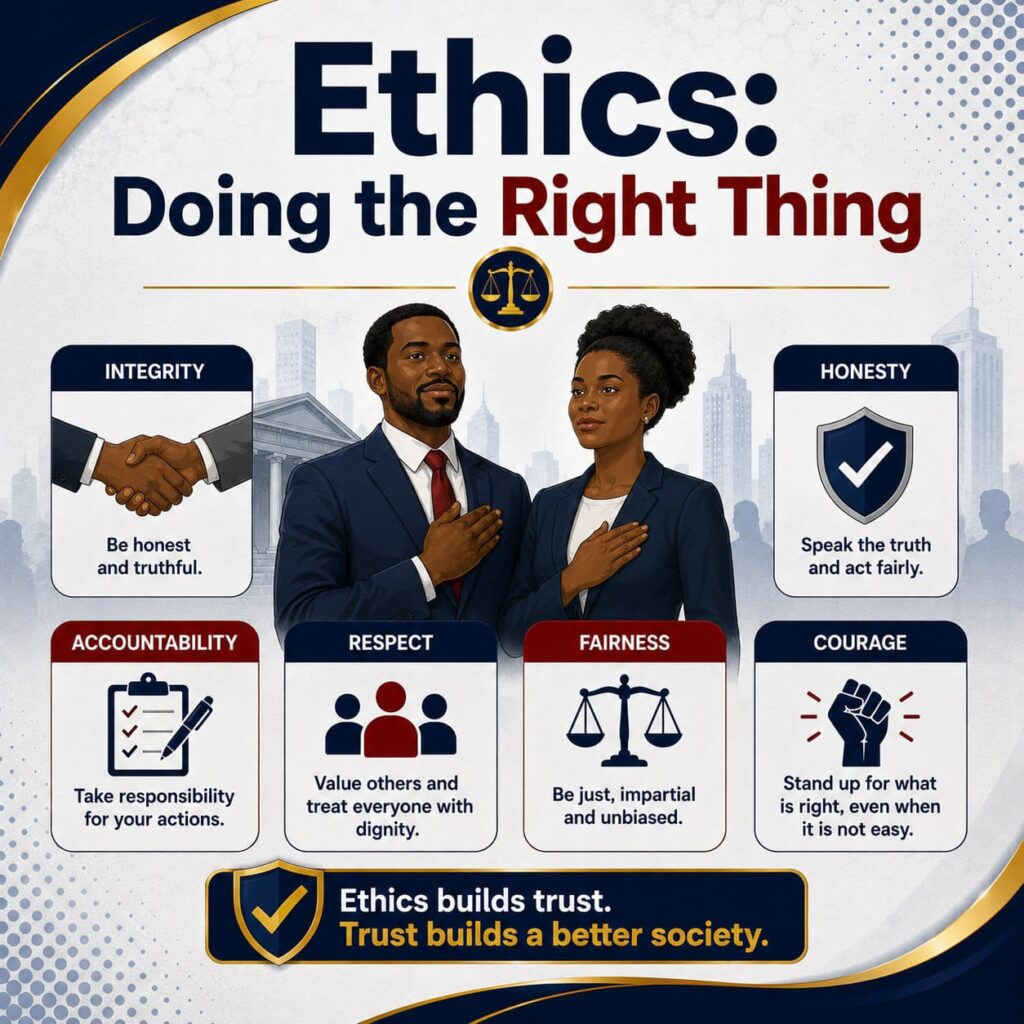
ETHICS: DOING THE RIGHT THING
Your biggest test of character is not what you do when people are watching.
It is what you do when no one is.
There are no cameras.
No auditors.
No supervisors.
No witnesses.
Only you…
…and your conscience.
That is where ethics begins.
Ethics is the ability to consistently choose what is right—even when it is inconvenient, unpopular, or costly.
Many people confuse what is legal with what is ethical.
They are not always the same.
Something may be legal but still be unethical.
Likewise, something may not be specifically prohibited by policy but can still violate the values of honesty, fairness, and integrity.
Ethics asks a different question.
Not “Can I do this?”
But “Should I do this?”
An ethical person asks:
- Is this honest?
- Is this fair?
- Would I be comfortable if this decision appeared on the front page of tomorrow’s newspaper?
- Would I make the same decision if my family, employer, or the public were watching?
Ethics is making the right decision before someone forces you to.
Every organization depends on ethical people.
Policies cannot watch every employee.
Auditors cannot check every transaction.
Managers cannot supervise every decision.
When ethics is absent, no number of rules will stop corruption.
When ethics is present, fewer rules are needed.
Remember this.
Laws tell you what you must not do.
Ethics guides you toward what you should do.
Your integrity is measured not by your words, but by the decisions you make when nobody can stop you from doing the wrong thing.

INTEGRITY IN EVERYDAY LIFE & THE WORKPLACE
Integrity is expensive.
That is why not everyone can afford it.
It may cost you money.
It may cost you promotions.
It may cost you friendships.
It may even cost you opportunities.
But losing your integrity will cost you far more.
Integrity is doing the right thing consistently—even when it brings no reward and no one is watching.
It is not something you switch on at work and switch off at home.
Integrity is a lifestyle.
It is reflected in the small decisions people make every day.
Do you tell the truth?
Do you keep your promises?
Do you return what does not belong to you?
Do you admit your mistakes?
Do you refuse to take shortcuts?
That is integrity.
In the workplace, integrity means:
- Being honest in reports and records.
- Arriving at work and leaving at the correct time.
- Declaring conflicts of interest.
- Protecting confidential information.
- Using organizational resources responsibly.
- Refusing gifts or favours that could influence your decisions.
- Treating everyone fairly, regardless of status or relationship.
Integrity is not only about avoiding corruption.
It is about earning trust.
A person with integrity does not need to constantly defend their reputation.
Their actions speak for them.
Organizations built on integrity enjoy stronger teamwork, better decision-making, greater public confidence, and long-term success.
Organizations without integrity eventually pay the price through fraud, poor performance, legal problems, and damaged reputations.
Remember this.
Skills may get you a job.
Experience may earn you a promotion.
But integrity determines whether people will continue to trust you with responsibility.
Your reputation is built one decision at a time.
Protect it at all costs.
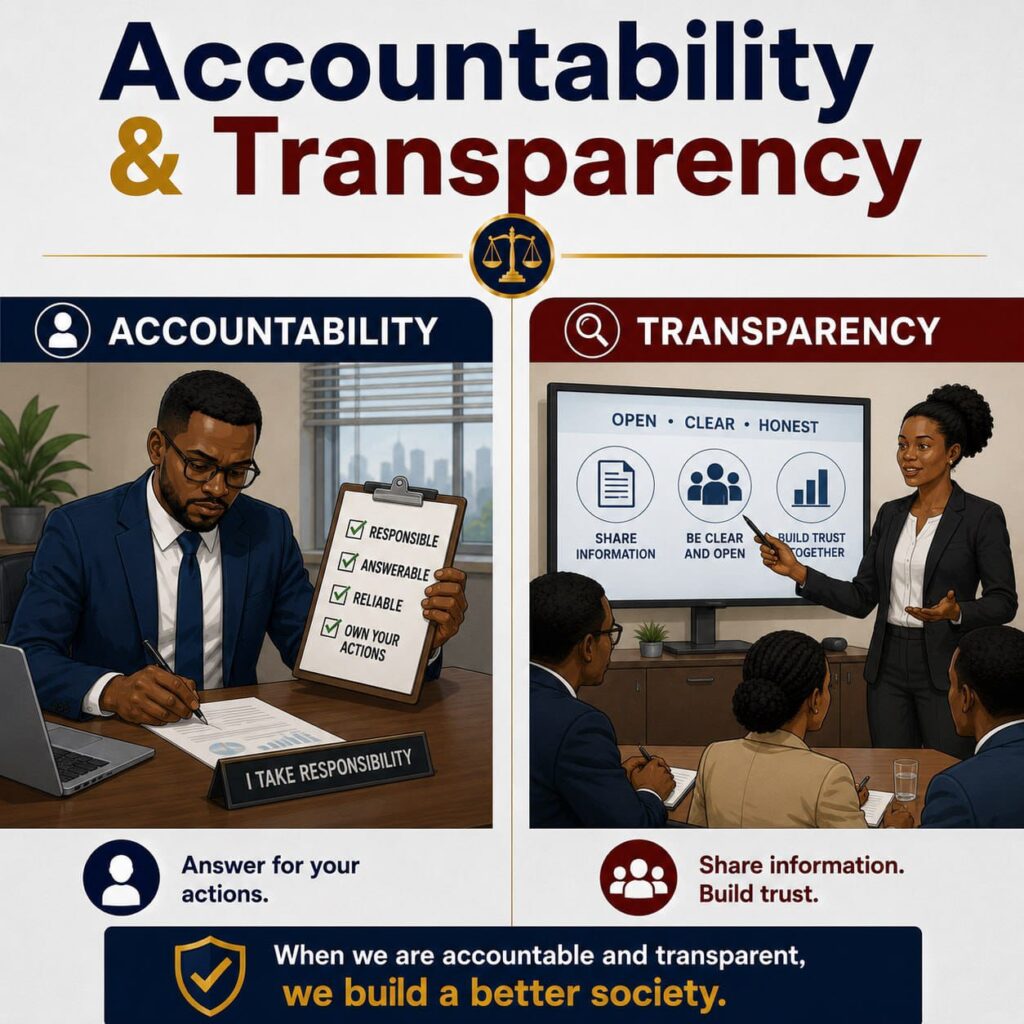
ACCOUNTABILITY & TRANSPARENCY
Power without accountability is an invitation to corruption.
When people believe they will never be questioned…
They become careless.
Then dishonest.
Then corrupt.
That is why accountability and transparency are the foundation of every ethical organization.
ACCOUNTABILITY
Accountability means accepting responsibility for your actions, decisions, and their consequences.
It means being prepared to explain:
Why you made a decision.
How you spent the money.
Why you approved the contract.
Why you hired the employee.
Why you took a particular action.
If you cannot explain it, you probably should not have done it.
Accountability is not about blaming people.
It is about owning your decisions.
TRANSPARENCY
Transparency means being open, honest, and clear about how decisions are made.
It removes secrecy.
It reduces suspicion.
It builds confidence.
Transparent organizations have:
- Clear policies and procedures.
- Fair recruitment processes.
- Competitive procurement systems.
- Accurate financial records.
- Open communication.
- Proper documentation.
Transparency allows people to see that the process was fair—not just the outcome.
Corruption thrives in darkness.
Integrity thrives in openness.
The more hidden a process is, the greater the opportunity for manipulation.
The more transparent a process is, the harder it becomes to abuse.
Remember this.
People do not fear accountability because they made mistakes.
They fear accountability because they know they acted dishonestly.
Transparency discourages corruption.
Accountability exposes it.
Together, they protect organizations, public trust, and the people they serve.
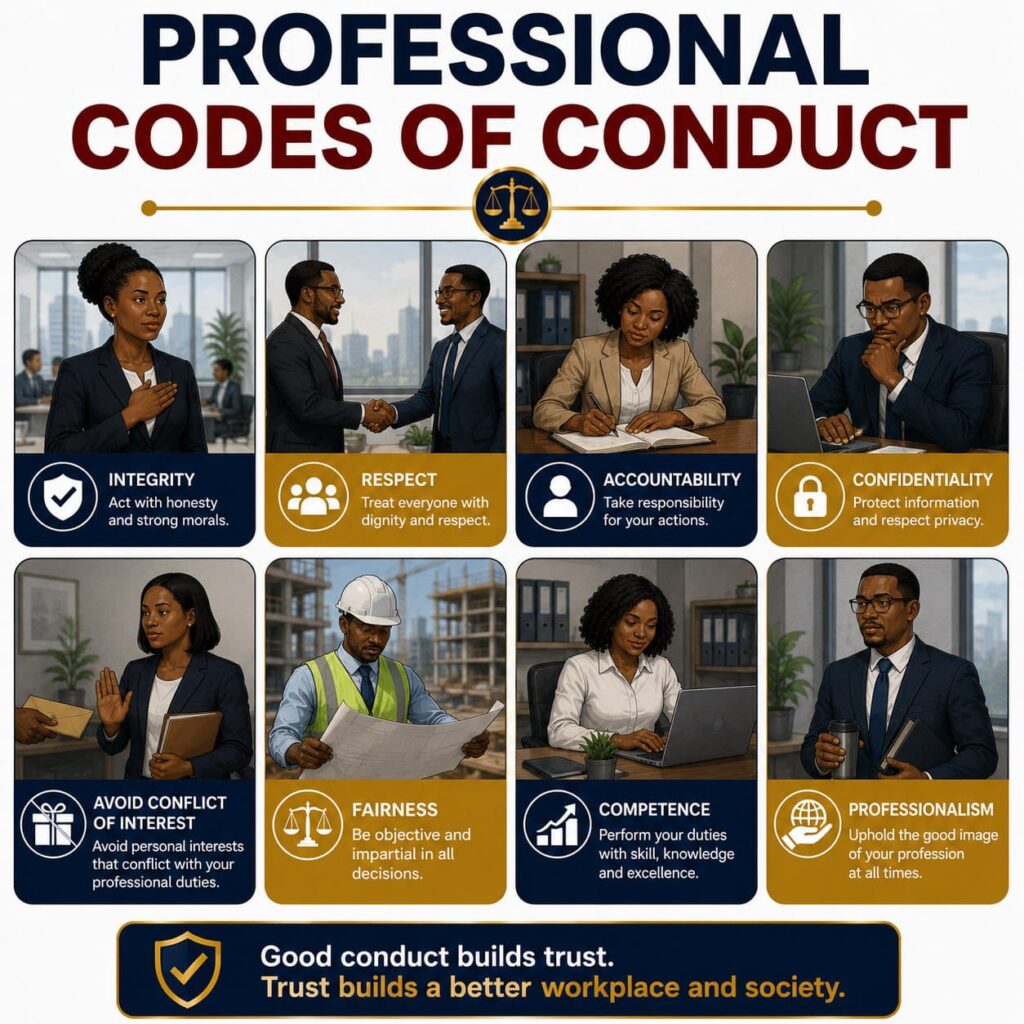
PROFESSIONAL CODES OF CONDUCT
Your job gives you authority.
Your code of conduct tells you how to use it.
Without professional standards, every employee would decide for themselves what is acceptable.
One person would accept gifts.
Another would manipulate records.
Another would misuse company property.
Soon, the organization would descend into chaos.
That is why every reputable organization has a Code of Conduct.
A Code of Conduct is a set of ethical principles and behavioural standards that guide how employees are expected to act.
It exists to protect:
- The organization.
- Its employees.
- Its customers or citizens.
- Its reputation.
A professional Code of Conduct typically requires employees to:
- Act honestly and with integrity.
- Comply with laws, regulations, and organizational policies.
- Treat everyone fairly and with respect.
- Protect confidential information.
- Avoid conflicts of interest.
- Refuse bribery and other improper benefits.
- Use organizational resources responsibly.
- Report unethical or illegal behaviour.
Signing a Code of Conduct is easy.
Living by it is the real test.
Many organizations have excellent policies.
The problem is not the policy.
The problem is that people choose to ignore it when it becomes inconvenient.
A code of conduct has value only when it influences behaviour.
Every employee has a choice.
You can become part of the problem…
Or part of the culture that protects integrity.
Remember this.
A Code of Conduct is more than a document.
It is a commitment.
Professionalism is not measured by your job title.
It is measured by how faithfully you uphold the standards of your profession—even when no one is watching.
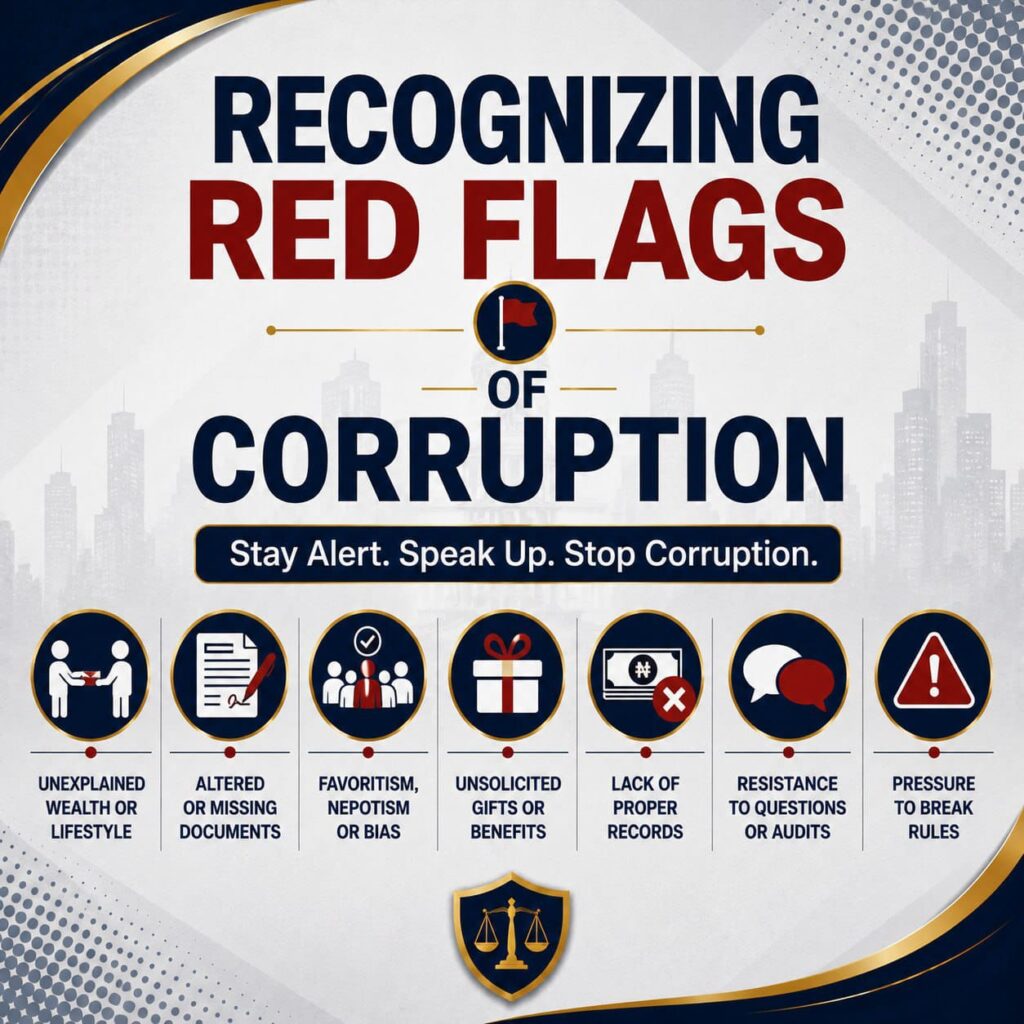
RECOGNIZING RED FLAGS OF CORRUPTION
Corruption rarely announces itself.
It leaves clues.
Small warning signs.
Unusual behaviour.
Suspicious decisions.
The people who spot these red flags early often prevent major financial losses, reputational damage, and criminal investigations.
A red flag does not automatically mean corruption has occurred.
It means something deserves closer attention.
Never ignore warning signs simply because the person involved is senior, influential, or trusted.
Some of the most common red flags include:
- An employee living far beyond their known income.
- Contracts repeatedly awarded to the same supplier without proper competition.
- Urgent requests to bypass normal procedures or approvals.
- Missing, altered, or incomplete financial records.
- Unexplained cash transactions.
- Employees refusing to take annual leave because they fear someone may discover irregularities.
- Close personal relationships between decision-makers and suppliers that are never disclosed.
- Excessive secrecy around procurement, recruitment, or financial decisions.
- Gifts, expensive hospitality, or favours offered before important decisions are made.
- Unusual resistance to audits, inspections, or independent reviews.
- Repeated splitting of purchases to avoid approval limits.
- Employees insisting that “this is how we’ve always done it.”
One red flag may have an innocent explanation.
Several red flags together demand immediate attention.
Organizations that ignore warning signs often discover the problem only after significant damage has been done.
Corruption is easier to prevent than to investigate.
That is why vigilance is everyone’s responsibility—not just auditors, compliance officers, or anti-corruption agencies.
Remember this.
Most corruption scandals never begin as scandals.
They begin as warning signs that someone chose to ignore.
The earlier you recognize the red flags, the easier it is to protect your organization, your reputation, and the people who depend on your integrity.
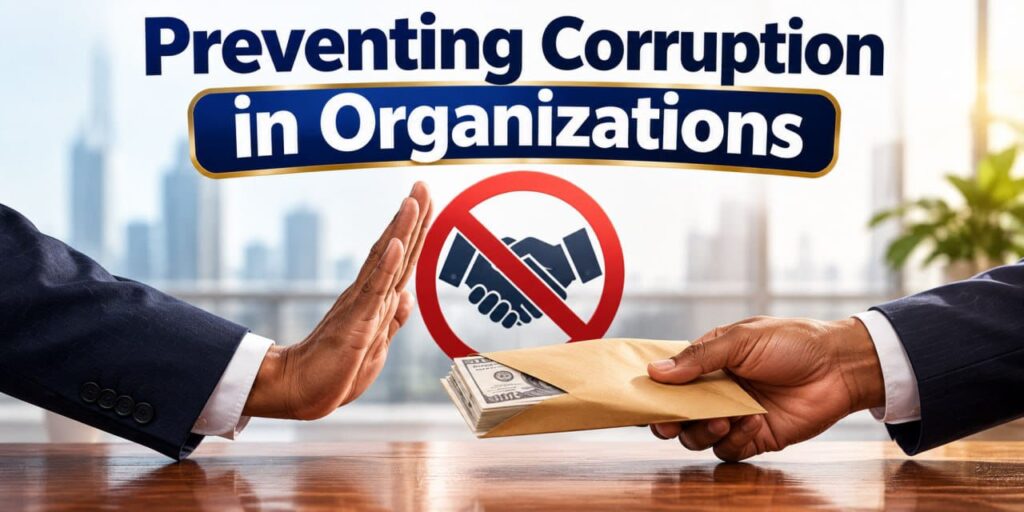
PREVENTING CORRUPTION IN ORGANIZATIONS
The best time to fight corruption is before it happens.
Once money has been stolen…
Once evidence has been destroyed…
Once public trust has been lost…
The damage is already done.
Strong organizations do not wait for corruption.
They make corruption difficult to commit.
Preventing corruption is not the responsibility of the Managing Director alone.
It is not the responsibility of Internal Audit alone.
It is not the responsibility of Compliance alone.
It is everyone’s responsibility.
Organizations that successfully prevent corruption have certain characteristics in common.
They build systems—not excuses.
These organizations:
- Recruit people based on merit, not connections.
- Establish clear policies and enforce them consistently.
- Separate responsibilities so that no one person controls an entire process.
- Maintain accurate and complete financial records.
- Conduct regular internal and external audits.
- Require competitive procurement processes.
- Protect whistleblowers and encourage ethical reporting.
- Train employees regularly on ethics and anti-corruption.
- Investigate allegations promptly and fairly.
- Hold everyone accountable—regardless of rank or position.
Culture is just as important as policy.
You can have the best anti-corruption policy in the world.
If leaders ignore it…
Employees will ignore it too.
People watch what leaders do, not what they say.
A culture of integrity starts at the top and spreads throughout the organization.
Remember this.
Corruption thrives where controls are weak.
Integrity thrives where accountability is strong.
A strong anti-corruption system protects more than money.
It protects people.
It protects reputations.
It protects public confidence.
And it protects the future of the organization.
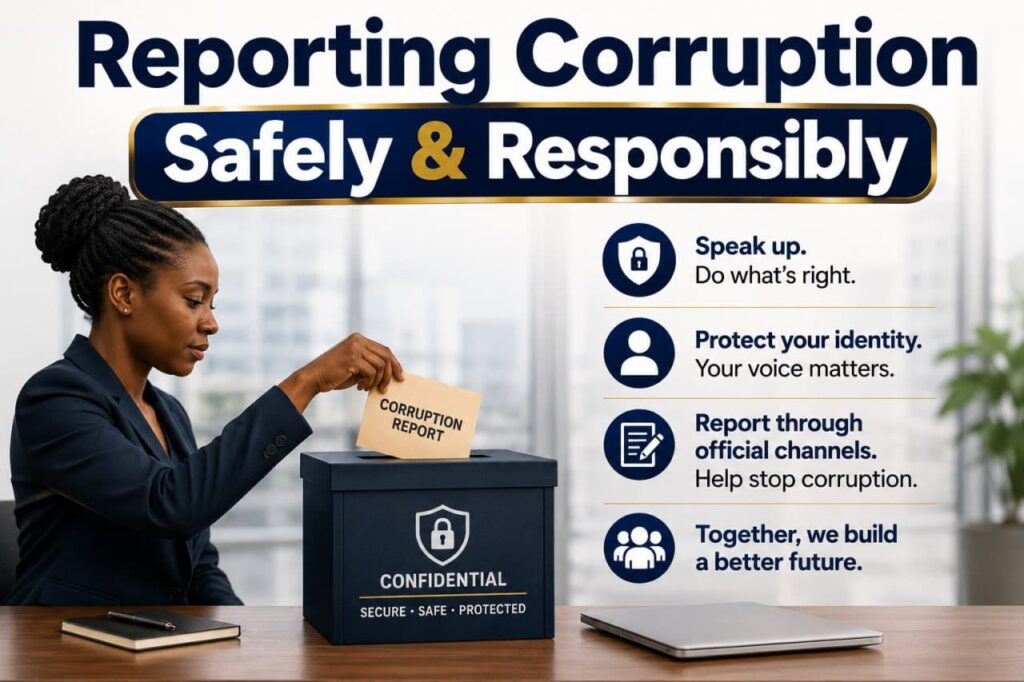
REPORTING CORRUPTION SAFELY & RESPONSIBLY
Knowing about corruption and staying silent allows it to grow.
Every corruption scandal continued because someone knew…
…but nobody spoke.
Silence protects the corrupt.
Courage protects the organization.
Reporting corruption is not betrayal.
It is a professional and ethical responsibility.
If you witness or reasonably suspect corruption, do not ignore it.
Do not participate in it.
Do not help to cover it up.
Do not spread rumours without evidence.
Report it through the appropriate channels.
Responsible reporting is based on facts—not assumptions.
Before making a report:
- Record what you observed.
- Preserve relevant documents or evidence where appropriate and lawful.
- Report only what you know to be true.
- Avoid exaggeration or personal attacks.
- Maintain confidentiality throughout the process.
Most organizations provide official reporting channels such as:
- Immediate supervisors.
- Human Resources.
- Compliance or Ethics Offices.
- Internal Audit.
- Dedicated whistleblower hotlines or reporting platforms.
- Relevant anti-corruption or law enforcement agencies where necessary.
A report made honestly and in good faith is an act of integrity.
Making a false accusation, however, can seriously damage innocent people and undermine trust in the reporting process.
That is why every allegation should be investigated fairly, objectively, and confidentially.
Organizations also have a responsibility to protect individuals who report concerns in good faith from retaliation, intimidation, or unfair treatment.
Remember this.
Corruption survives because good people remain silent.
Integrity begins the moment someone has the courage to speak up.
One honest report can prevent enormous financial loss, protect countless people, and preserve the reputation of an entire organization.
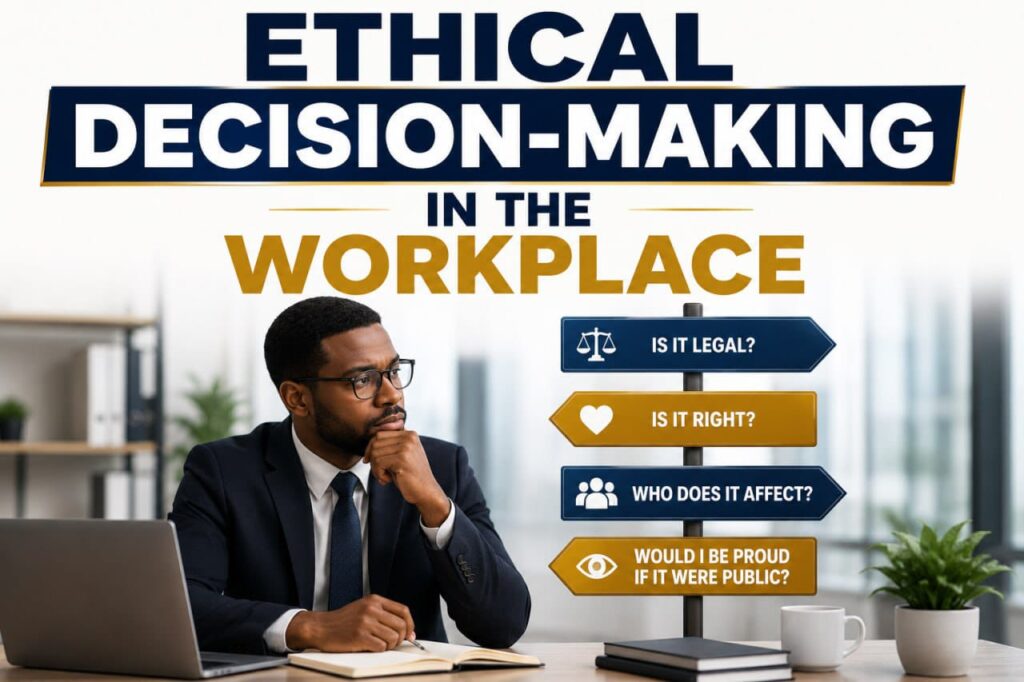
ETHICAL DECISION-MAKING IN THE WORKPLACE
Corruption rarely begins with a suitcase full of cash.
It usually begins with a decision.
A small compromise.
A favour.
An excuse.
A moment when someone convinces themselves that “it won’t matter.”
Every day, professionals are faced with choices that test their integrity.
Not every situation is black and white.
Some are subtle.
Some involve pressure from senior management.
Some involve family, friends, or influential people.
Your ability to make the right decision before a crisis occurs is one of the greatest professional skills you can develop.
Before making any important workplace decision, ask yourself these five questions:
- IS IT LEGAL?
Does this action comply with the law, organizational policies, and professional regulations?
- IS IT HONEST?
Am I being truthful, transparent, and fair?
Am I hiding information or misleading anyone?
- IS IT FAIR?
Would every qualified person have an equal opportunity?
Or am I giving someone an unfair advantage?
- CAN I DEFEND THIS DECISION PUBLICLY?
If this decision appeared on the front page of tomorrow’s newspaper…
Would I be proud of it?
Or would I be embarrassed to explain it?
- WOULD I MAKE THE SAME DECISION IF MY FAMILY OR CHILDREN WERE WATCHING?
Integrity is often revealed by the answer to this question.
If the answer is no…
Don’t do it.
Ethical decisions are not always the easiest decisions.
Sometimes doing the right thing is uncomfortable.
Sometimes it is unpopular.
Sometimes it comes at a personal cost.
But in the long run, integrity always costs less than corruption.
Remember this.
Every corruption scandal began with someone making a bad decision.
Every ethical organization is built by people making the right one.
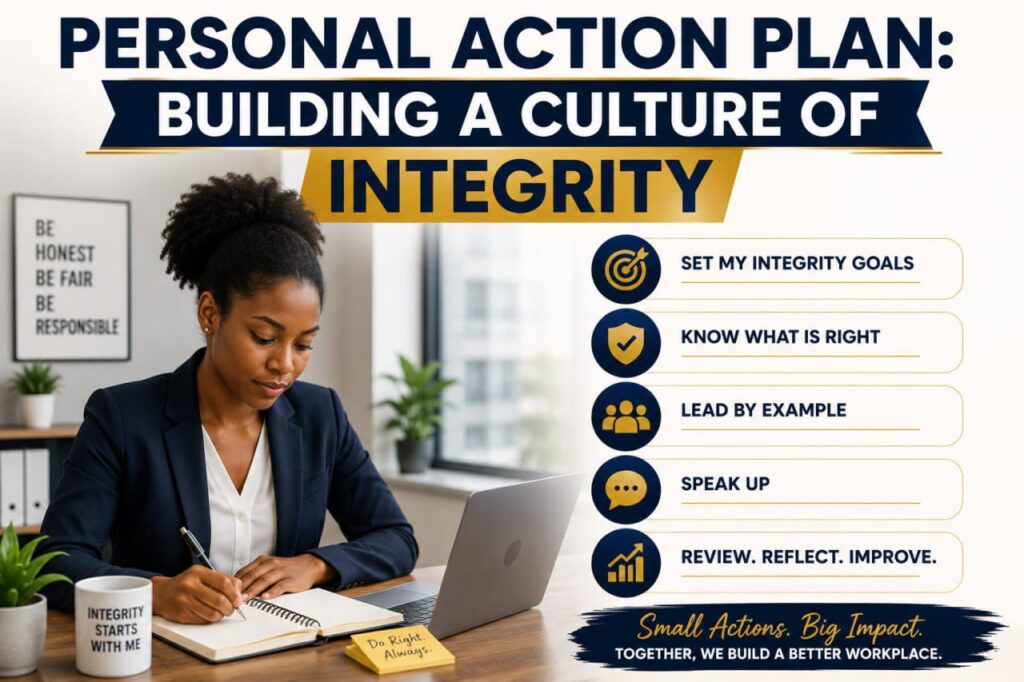
BUILDING A CULTURE OF INTEGRITY
Don’t wait for your organization to change before you change.
Every culture—good or bad—is created by the daily choices of ordinary people.
One honest employee.
One ethical manager.
One principled leader.
That is how a culture of integrity begins.
Many people believe they cannot make a difference because they are “just one person.”
History proves otherwise.
Every major corruption scandal involved individuals making dishonest choices.
Every respected organization is built by individuals making honest ones.
A culture of integrity is not built through slogans on office walls.
It is built through consistent actions.
You can contribute by:
- Refusing to give or receive bribes.
- Following policies and procedures—even when shortcuts seem easier.
- Declaring conflicts of interest immediately.
- Treating everyone fairly, regardless of status or relationship.
- Keeping accurate records and documentation.
- Speaking up when you witness unethical behaviour.
- Protecting confidential information.
- Leading by example, even when others choose the wrong path.
Remember that people watch your behaviour more than they listen to your words.
Your colleagues.
Your subordinates.
Your supervisors.
Your family.
Your community.
Integrity is contagious.
When one person refuses to compromise, others are encouraged to do the same.
When leaders demonstrate integrity consistently, ethical behaviour becomes the standard—not the exception.
Real change does not begin in parliament.
It does not begin in the courtroom.
It does not begin in the boardroom.
It begins with individual decisions made every single day.
Remember this.
Policies can prevent corruption.
Laws can punish corruption.
But only people of integrity can eliminate it.
Be the person who raises the standard—not the one who lowers it.
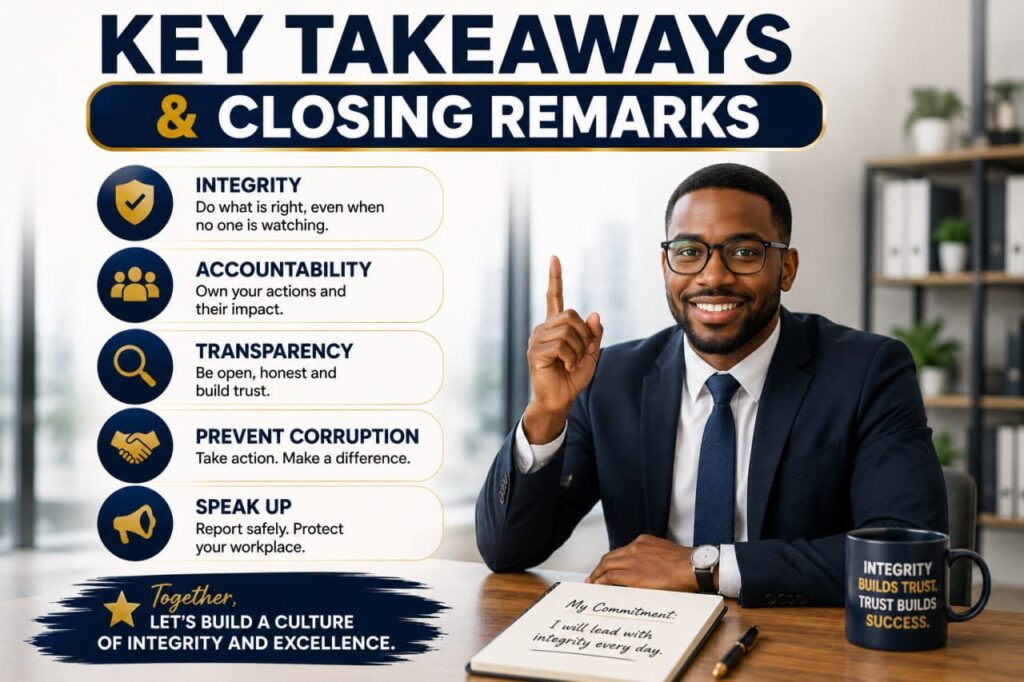
FINAL THOUGHTS & CLOSING REMARKS
This session ends here.
Your responsibility does not.
today, you have learned that corruption is not just about stolen money.
It is about broken trust.
Abused power.
Unfair decisions.
Lost opportunities.
And lives affected by the choices of dishonest people.
You have explored:
- What corruption is and how it occurs.
- The different forms of corruption.
- Why corruption happens.
- The devastating impact it has on individuals, organizations, and society.
- The importance of ethics, integrity, accountability, and transparency.
- How organizations can prevent corruption.
- How to recognize warning signs.
- How to report corruption safely and responsibly.
Most importantly, you have learned that the fight against corruption begins with individual character.
No anti-corruption agency can be present in every office.
No auditor can review every transaction.
No supervisor can monitor every decision.
Integrity fills the gap where supervision ends.
As you leave this training, remember these simple principles:
Do what is right.
Tell the truth.
Favour James, a Nigerian dementia support worker working in a residential care facility in Bristol, United Kingdom, was assigned to care for Mrs. Margaret Lewis, a 79-year-old woman living with advanced dementia.
During the daytime, Mrs. Lewis was usually calm and cooperative.
She could:
✔️ Eat with assistance
✔️ Hold short conversations
✔️ Recognize some staff members occasionally
But every evening, her behavior changed dramatically.
As sunset approached, Mrs. Lewis often became:
✖️ Restless
✖️ Confused
✖️ Irritable
✖️ Emotionally distressed
One evening around 7 PM, she suddenly became frightened and pointed toward a dark corner of the room.
She shouted:
“Why are those children standing there watching me?”
However, nobody else could see anyone in the room.
Mrs. Lewis became increasingly terrified.
She started:
✖️ Crying
✖️ Refusing care
✖️ Attempting to leave the room
✖️ Accusing staff of hiding “strangers” inside the facility
A newly employed staff member responded harshly:
“There is nobody there! Stop imagining things!”
This only made Mrs. Lewis more frightened and agitated.
Favour quickly noticed the situation worsening.
Instead of arguing, she calmly approached the patient and said softly:
“You are safe, Mrs. Lewis. I am here with you.”
She then:
✔️ Reduced noise in the environment
✔️ Switched on better lighting
✔️ Redirected Mrs. Lewis gently toward another activity
✔️ Stayed beside her calmly until she settled
Over time, the patient became less distressed.
Later that night, Mrs. Lewis accused another resident of stealing her handbag.
Staff members eventually found the handbag hidden inside her own wardrobe, where she had forgotten placing it earlier.
Favour understood that the patient was not intentionally lying.
The dementia was affecting:
✔️ Memory
✔️ Judgment
✔️ Reality perception
A few days later, Mrs. Lewis suddenly became far more confused than usual.
She started:
✖️ Talking to imaginary figures constantly
✖️ Becoming severely restless
✖️ Sleeping poorly
✖️ Struggling to recognize familiar staff
Favour immediately reported the sudden deterioration to the supervising nurse.
Medical assessment later revealed that Mrs. Lewis had developed an infection causing delirium, which had worsened the hallucinations and confusion significantly.
IMPORTANT PROFESSIONAL LESSONS FROM THIS SCENARIO
Favour demonstrated professional dementia care skills by:
✔️ Remaining calm during hallucinations
✔️ Avoiding aggressive confrontation
✔️ Reassuring the patient emotionally
✔️ Recognizing sundowning behaviors
✔️ Observing sudden deterioration carefully
✔️ Escalating concerns appropriately
FINAL REALITY CHECK
For dementia patients:
✔️ Hallucinations may feel completely real
✔️ Delusions may feel believable
✔️ Evening confusion may become frightening and overwhelming
Professional caregivers must respond with:
✔️ Patience
✔️ Reassurance
✔️ Observation
✔️ Safety-focused care
✔️ Emotional support
COMMUNICATION PROBLEMS IN DEMENTIA
One of the most painful effects of dementia is this:
The person may still have emotions…
still have needs…
still feel fear or discomfort…
…but gradually lose the ability to communicate clearly.
And when communication breaks down:
➤ Frustration increases
➤ Isolation grows
➤ Behavioral problems may worsen
➤ Care becomes more difficult
This is why communication is one of the most important skills in dementia care.
HOW DEMENTIA AFFECTS COMMUNICATION
Dementia can damage brain areas responsible for:
✔️ Language
✔️ Understanding
✔️ Speech processing
✔️ Word retrieval
✔️ Attention
✔️ Memory
As a result, patients may struggle to:
➤ Find the right words
➤ Follow conversations
➤ Understand instructions
➤ Express emotions properly
➤ Process information quickly
Communication problems usually worsen as dementia progresses.
COMMON COMMUNICATION DIFFICULTIES
➤ Repeating questions frequently
➤ Losing words during conversations
➤ Using incorrect words
➤ Forgetting names of objects
➤ Difficulty understanding complex sentences
➤ Becoming silent or withdrawn
➤ Losing track during conversations
Some patients may pause often because:
The brain is struggling to retrieve language.
Others may become frustrated or angry when they cannot express themselves.
UNDERSTANDING VS SPEAKING
Some dementia patients can still speak…
but may not fully understand what others are saying.
Others may understand more than they can express.
This mismatch can create:
✔️ Confusion
✔️ Embarrassment
✔️ Emotional distress
A patient may nod during conversation…
while internally struggling to understand what is happening.
WHY PATIENTS MAY BECOME AGITATED
Imagine:
➤ Hearing words that no longer make sense
➤ Trying to speak but failing
➤ Feeling misunderstood constantly
Communication failure can trigger:
➤ Aggression
➤ Withdrawal
➤ Anxiety
➤ Fear
➤ Resistance to care
Sometimes what appears as “difficult behavior” is actually:
Communication distress.
COMMON CAREGIVER MISTAKES
Avoid:
✖️ Speaking too fast
✖️ Giving multiple instructions at once
✖️ Shouting unnecessarily
✖️ Arguing aggressively
✖️ Correcting every mistake
✖️ Talking to the patient like a child
These responses may worsen confusion or humiliation.
EFFECTIVE COMMUNICATION TECHNIQUES
Instead:
✔️ Speak slowly and clearly
✔️ Use short simple sentences
✔️ Maintain eye contact
✔️ Use calm tone of voice
✔️ Give one instruction at a time
✔️ Allow extra time for responses
✔️ Use gestures and visual cues
✔️ Reduce background noise
Sometimes:
✔️ Facial expressions
✔️ Touch
✔️ Body language
✔️ Reassurance
…communicate more effectively than words.
NON-VERBAL COMMUNICATION BECOMES VERY IMPORTANT
In advanced dementia, speech may reduce significantly.
But patients may still communicate through:
➤ Facial expressions
➤ Restlessness
➤ Crying
➤ Withdrawal
➤ Body movements
➤ Changes in behavior
A restless patient may be:
✔️ In pain
✔️ Afraid
✔️ Hungry
✔️ Overstimulated
✔️ Trying to communicate discomfort
Observation becomes critical.
Important Clinical Reality
A patient who cannot communicate properly may also struggle to report:
➤ Pain
➤ Infection
➤ Breathing difficulty
➤ Emotional distress
➤ Hunger or thirst
This increases vulnerability significantly.
Healthcare workers must therefore become highly observant and emotionally sensitive.
Powerful Emotional Truth
Imagine slowly losing the ability to:
➤ Express your thoughts
➤ Explain your needs
➤ Understand conversations
➤ Defend yourself verbally
Imagine the loneliness that creates.
Many dementia patients live daily inside that silent frustration.
And sometimes…
The greatest act of care is not merely speaking to the patient…
…but learning how to truly listen beyond words.
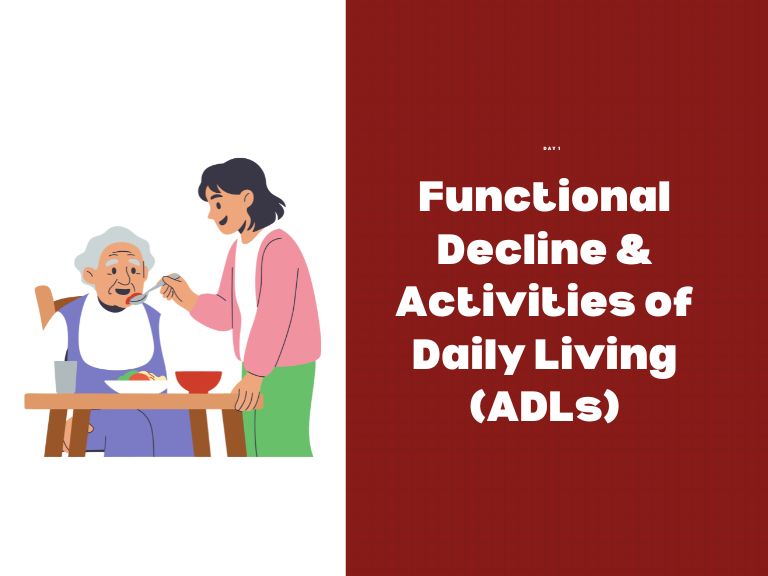
FUNCTIONAL DECLINE & ACTIVITIES OF DAILY LIVING (ADLs)
One major sign of dementia progression is:
Gradual loss of ability to perform daily activities independently.
At first, the changes may seem small.
But over time, simple tasks become difficult or impossible.
This affects:
➤ Safety
➤ Hygiene
➤ Feeding
➤ Mobility
➤ Personal dignity
WHAT ARE ADLs?
ADLs are basic daily activities needed for independent living.
They include:
✔️ Eating
✔️ Bathing
✔️ Dressing
✔️ Toileting
✔️ Grooming
✔️ Walking or mobility
✔️ Managing continence
As dementia progresses, these skills slowly decline.
EARLY FUNCTIONAL DECLINE
In early stages, patients may struggle with:
➤ Managing medications
➤ Cooking safely
➤ Handling money
➤ Following instructions
➤ Remembering appointments
They may:
✔️ Forget bills
✔️ Leave appliances on
✔️ Miss medications
These changes can create safety risks.
MIDDLE-STAGE FUNCTIONAL DECLINE
As dementia worsens, the patient may struggle with:
✔️ Bathing
✔️ Dressing
✔️ Toileting
✔️ Hygiene
✔️ Eating independently
Some may:
➤ Wear clothes incorrectly
➤ Resist bathing
➤ Wander unsafely
➤ Become incontinent
Supervision and assistance become increasingly necessary.
LATE-STAGE FUNCTIONAL DECLINE
In advanced dementia, the patient may become:
➤ Fully dependent on caregivers
➤ Unable to walk safely
➤ Unable to swallow properly
➤ Bedridden
➤ Unable to communicate needs
Complications may include:
➤ Falls
➤ Pressure ulcers
➤ Malnutrition
➤ Infections
➤ Aspiration pneumonia
WHY FUNCTIONAL DECLINE HAPPENS
Dementia damages brain areas responsible for:
✔️ Memory
✔️ Planning
✔️ Coordination
✔️ Judgment
✔️ Movement sequencing
The body may still function physically…
but the brain can no longer guide tasks properly.
EMOTIONAL IMPACT
Functional decline may cause:
➤ Frustration
➤ Fear
➤ Anger
➤ Embarrassment
➤ Loss of confidence
Some patients resist care because they feel confused or humiliated.
HOW CAREGIVERS SHOULD RESPOND
Avoid:
✖️ Rushing the patient
✖️ Shaming mistakes
✖️ Speaking harshly
Instead:
✔️ Encourage independence where possible
✔️ Give simple instructions
✔️ Maintain dignity and privacy
✔️ Use patience and reassurance
✔️ Ensure safety calmly
IMPORTANT PROFESSIONAL LESSON
A dementia patient is not “lazy.”
The brain is gradually losing the ability to:
➤ Plan actions
➤ Remember steps
➤ Coordinate tasks
➤ Maintain independence safely
Advanced dementia care is not only about survival.
It is also about:
✔️ Dignity
✔️ Comfort
✔️ Compassion
✔️ Humanity
Lorem ipsum dolor sit amet, consectetur adipiscing elit. Ut elit tellus, luctus nec ullamcorper mattis, pulvinar dapibus leo.
Lorem ipsum dolor sit amet, consectetur adipiscing elit. Ut elit tellus, luctus nec ullamcorper mattis, pulvinar dapibus leo.
Lorem ipsum dolor sit amet, consectetur adipiscing elit. Ut elit tellus, luctus nec ullamcorper mattis, pulvinar dapibus leo.